Introduction:
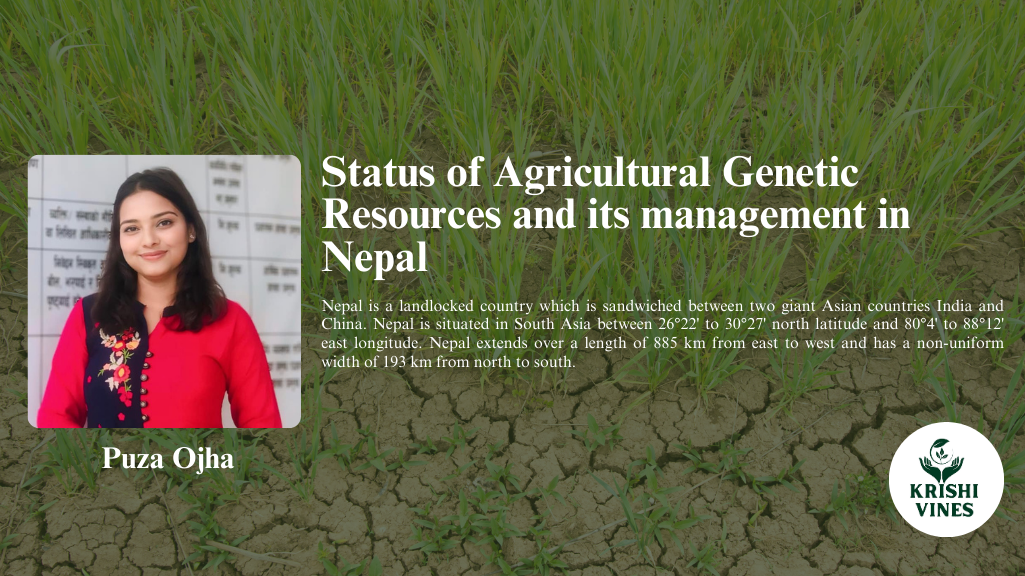
Nepal is a landlocked country which is sandwiched between two giant Asian countries India and China. Nepal is situated in South Asia between 26°22′ to 30°27′ north latitude and 80°4′ to 88°12′ east longitude. Nepal extends over a length of 885 km from east to west and has a non-uniform width of 193 km from north to south. It has a total land area of 147,516 km2. Nepal is predominantly a mountainous country with elevations ranging from 59 m above sea level (Mukhiyapatti Musharniya, Dhanusa) to 8848.86 m (Mt. Everest).
Nepal is richly endowed with agricultural biodiversity and genetic resource owing to its variation in temporal, altitudinal and topographical aspects. Rice, maize, wheat, millet, and potato are the principal crops grown in Nepal followed by sugarcane, Jute, cotton, tea, barley, legumes, vegetables, and fruits. Crops such as rice, bean, eggplant, buckwheat, soyabean, foxtail millet, citrus and mango have high genetic diversity relative to other food crops. Nepal, being proximal to the original and secondary sources of origin of different cultivated plants, has harbored numerous wild relatives of cultivated agricultural crop plant like rice, wheat, barely, buckwheat, citrus and other fruit crops, several vegetable crops, etc. It is reported that 83 different wild relatives of 46 genera under 18 families of 36 agricultural crops exist.
Although the nation holds less than 0.1% of the earth’s landmass, it supports 2.2% of flowering plants, 1.4% of reptiles, of reptiles, 2.2% of fish, 8.5% of birds, 4.2% of butterflies and 4% of all mammals. Out of about 410 angiosperm families in the world, 203(almost 50%) are represented in Nepal. The Biodiversity Profiles Project (1995) ranked Nepal as having the tenth richest flowering plant diversity in Asia and 31st on a world scale. Also, more than 500 species of edible genetic resources are available here, of which nearly 200 species are under cultivation. However, commercialization, weak policy and regulatory framework, climate change, population growth, and youth immigration from rural areas have resulted in the decline of agriculture biodiversity.
Status of Plant Genetic Resources in Nepal:
Nepal is abundant in fruits, vegetables, grain legumes, cereals, and other foods. In Nepal, there are reports of four wild rice species (Oryza nivara, Oryza rufipogon, Oryza granulata, and Oryza officinalis), two wild relatives (Hygroryza aristata and Lersia hexandra), and various weedy rice varieties (Oryza sativa f. spontanea). In the same way, the hilly and mountainous areas have wild relatives of wheat. There have been reports of Aegilops and Agropyrum wheat species in Nepal so far. The nation is home to both major crops and underutilized species. Across the nation, there is diversity in terms of species and variation. There are a lot of underutilized species in both the natural and farmed populations. In Nepal, at least 11 of the 60 known species of amaranth have been identified, including wild, weedy, and cultivated varieties for grain and green vegetables. Only three of the 32 Hordeum species known to exist worldwide have been identified in Nepal. Hordeum vulgare is only cultivated species; the other two are wild species. Both naked and covered barley are widely accessible across the nation and are utilized for a variety of purpose, including religious purpose by both rural and urban communities. There have been reports of diversity in Nepal’s wild and cultivated forms of finger millet (Eleusine sp.) and buckwheat (Fagopyrum sp.).
Wild relatives of vegetable crops recorded in Nepal are Colocasia (3 spp.), Amaranthus (4 spp.), Chenopodium (2 spp.), Rumex (3 spp.), Pisum (3 spp.), Alium (3 spp.), Ipomoea (5 spp.), Dioscorea (4 spp.), Mentha (3 spp.), Trigonella (2 spp.), Solanum (2 spp.), Curcuma (5 spp.). Nine species of Prunus, 3 species each of Castanopsis, Malus, Morus and Rubus and 2 species each of Barberies, Ficus, Hippophae, Olea, Pyrus and Vitis are documented as temperate wild fruit relatives. Similarly, subtropical and tropical wild fruit relatives having more than one species are Annona, Citrus, Mangifera, Musa, Foenix and Rhus.
Some of the popular varieties of major crop species which are cultivated by farmers are mentioned below:
- Paddy – Radha 4, Radha 7, Jarneli, Jhinuwa, Gurdi, Gauriya, Thulo Jarneli, Seto Gudura, Jethobudho, Makwanpure, Sabitri, Anadi, Mansara
- Wheat – Rato, Hybrid, Gautam, Annapurna, Bhirkuti, Vijay, Aditya, Tilottama
- Finger millet – Local, Dalle, Okhle
- Maize – Arun, Bikase, Ceto, Rato, Ceto Murali, Manakamana, Pahelo.
- Mandarin – Syangja Local, Kinnow, Unshu
- Cucumber – Madale kaakro, Kushle, Bhaktapur local
- Cauliflower – Sthaniya, Kathmandu local
- Mango – Supari aap, Local
- Coffee – Arabica
- Potato – Cardinal, MS, Kalo, Nilo, Unnat, Local Red.
Nepal is rich in medicinal and aromatic plants with very high economic and Ethno-medicinal values, viz: Timur (Xanthoxylam armatum), Chap, Gurjo (Tinospora chinensis), Tulsi (Ocimum sanctum), Harro (Termenalia sp), Barro (Termenalia chebula), Ban lasun (Allium wallichii), Titepati (Artemisia gmelinii), Bojho (Acorus calamus), Sisnu (Urtica dioca), Tejpat (Laurus nobilis).
Challenges:
In spite of having high biodiversity, not enough efforts have been made to identify document, utilize and preserve them for the benefit of mankind. Many are on the verge of extinction. Some of the causes behind this are as follows:
- Lack of awareness among the local people.
- Insufficient funding for research and extension.
- Inadequate efforts of government on policy making and implementation.
- Increasing use of improved hybrid varieties and cultivars.
- Issues such as climate change and global warming.
Suggestions and recommendations:
- Spreading awareness among the local people by conducting effective awareness programs.
- More research and extension in related field.
- Allocation of more funds for documentation, preservation and other research activities.
- Implementation of government policy.
- Establishment of gene banks for conservation of local genetic resources.
Conclusion:
Overall, Nepal can be considered rich in terms of local agricultural biodiversity. However, with the exception of a few preferred major local varieties in all crops, many local varieties were found to be in declining order from farming practices. The main reasons for the extinction of local species include increasing use of improved / hybrid varieties, declining use of local crops in food, lack of information on the importance of indigenous crops, etc. It is well understood that the conservation and utilization of the available local agricultural biodiversity should be increased for the establishment of sustainable agricultural system. Hence, to improve household food security and crop biodiversity management, future research and development, interventions should focus on diversity-rich solutions and technologies customized to specific crops, socioeconomic, and farm agro-ecological situations of households.
In conclusion, loss of genetic diversity is the common threat to the sustainable use of plant genetic resources to meet the present needs and aspiration of future generation. Thus, it is essential to better understand the roles and values of the diversity of plant genetic resources in terms of economic, social, cultural and ecological value. Hence, the government of Nepal in collaboration with the local bodies should back up the valuable genetic diversity with proper conservation policies and strategies. Then, and there only, the agricultural genetic resources of Nepal can be sustained.