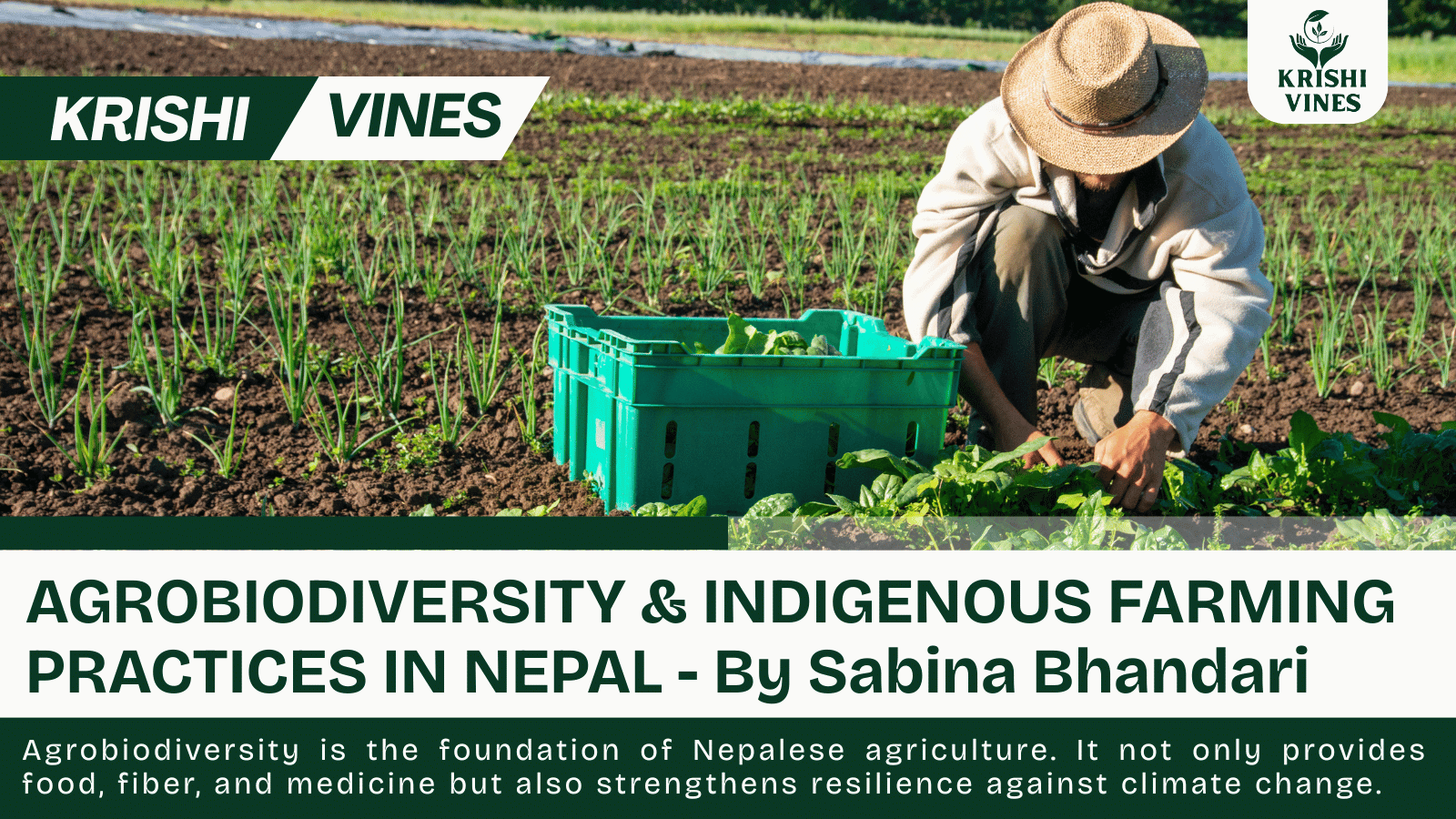
Nepal is an agricultural country consisting of about 30million population. Among 30 millions, about 60% of the population is engaged in agriculture. Nepal has diverse topography and climatic conditions and is home to a rich variety of crops and livestock as well as farming practices. This agricultural diversity is known as agrobiodiversity and it has been evolved through centuries of interaction between people and their environment. Nepal still follows its roots, indigenous farming practices filled with local knowledge and traditional equipments. The combination of indigenous farming practices , local knowledge and traditional equipment has played a crucial role in conserving this biodiversity and ensuring the sustainability of Nepalese agriculture. And its fair to say that indigenous farming practice is the backbone of Nepalese agriculture.
Agrobiodiversity involves the variety and variability of flora and faunna , microoraganisms which are used for food ,fiber, fodder and fuel in daily life. In Nepal we can see the diversity in the cultivation of various traditional crop varietied such as Jumli Marshi rice in Jumla district, Seto Makai (white maize) in the hills , and fox tail millet in the higher altitude regions of and Mansuli rice in Terai region of Nepal.
Indigenous farming practices uses the knowlegde that has been passed through generations to generations. Indigenous farming practices uses traditional knowledge and local materials, euipment for farming. It is based on cultural methods such as crop rotation, mixed cropping, and use of locally available organic maures. Indigenous farming practice use organic solutions for pest and diseases control , ensuring the enrichment of soil fertility and favors microbial activities of soil. Indigenous farming practices helps in saving seeds which ensures protection of local genetic resources ensuring that native varieties do not disappear due to modern hybrid seeds. It helps in protection of biodiversity and creates balance between flora and faunna. Indigenous farming practices does not only helps in preserving local seeds but also helps in preserving local culture , traditionals and food habits. The concept of sustainability is openly discussed and followed in the indigenous farming practices.
Farmers uses knowledge of weather , soil, and plant behavior which is passed through generations to generations. Farmers study the stars and cloud, winds direction to predict the weather. Indigenous farming practices creates a pleasant balance in the ecosystem. It uses the combined or mixed farming to utilize the resources mindfully. For e.g intercropping of maize with legumes , where maize provides support for legumes and legumes provides nutrient by nitrogen fixing in the soil. Knowledge of plants, soil, weather and geography is the backbone of indigenous farming practices. Agrobiodiversity involves the smooth coordination between flora and faunna . indigenous farming practices include the seed savings, seasonal farming calendars, and traditional irrigation systems like kulo and rajkulo.
However , having all those benefits of indigenous farming, the rapid expansion of commercial farming and hybrid seed availability is concealing the advantages . The rapid increase of hybrid seed has lead to loss of local seeds, traditional seed saving systems and harming the co-existence of flora and fauna in the ecosystem.
CONCLUSION
Agrobiodiversity and indigenous farming practices are integrated to each other and a crucial part of the ecological and cultural identity of Nepal. It ensures the environmental balance, sustainability and harmony and a resilience to the changing global climate. Nepalese culture and traditions is intertwined with the farming and foods. So to preserve the culture also we need to integrate indigenous farming knowledge with the modern agriculture system for smart agriculturing. To protect the heritage we should focus on recording traditional farming practices, promotion of community seed banks to preserve local seeds, and use of planting calendars for seasonal farming. Preserving agrobiodiversity is not only about conserving the past but also about securing the future of sustainable agriculture in Nepal.