Eastern Nawalparasi | December 7
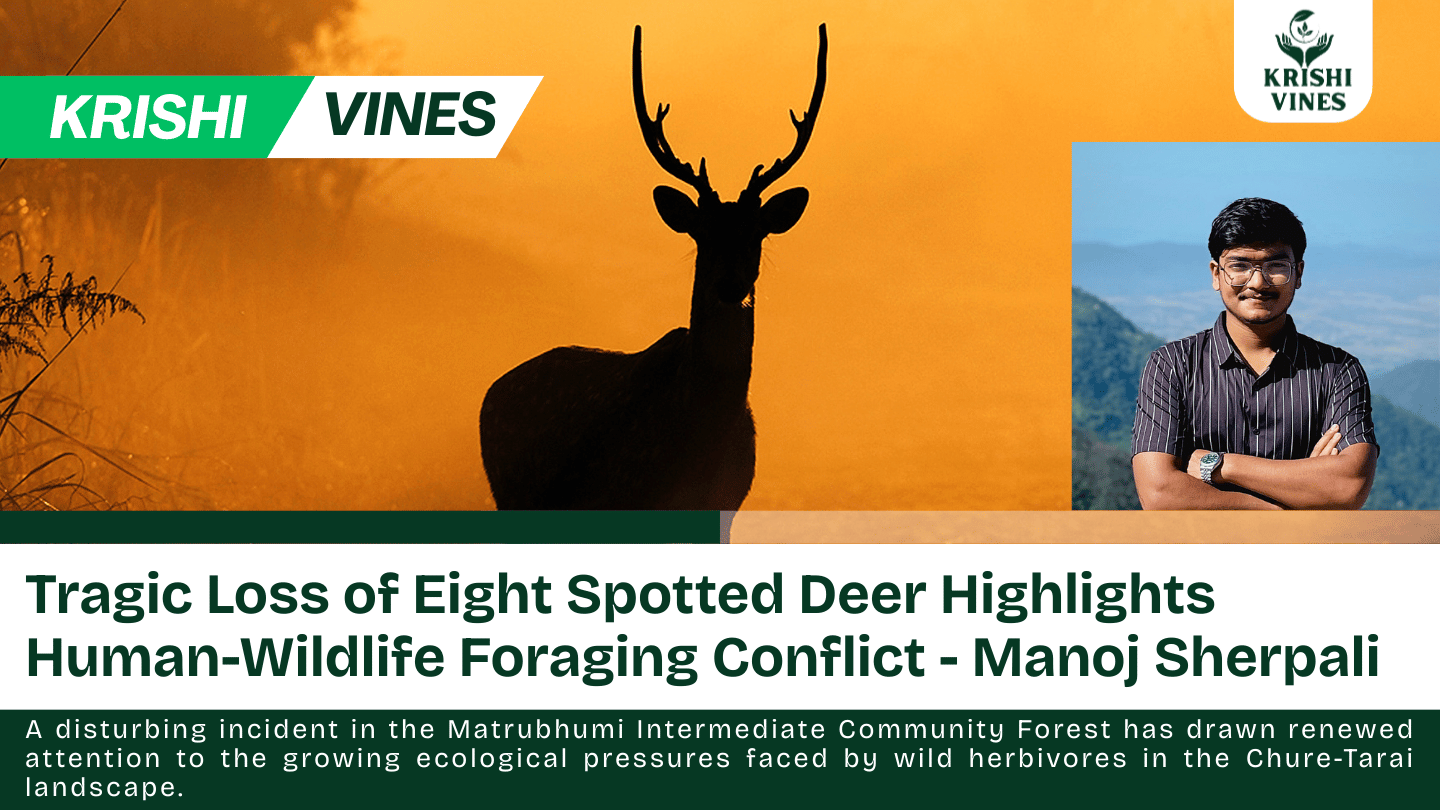
A disturbing incident in the Matrubhumi Intermediate Community Forest has drawn renewed attention to the growing ecological pressures faced by wild herbivores in the Chure-Tarai landscape. Eight spotted deer (Axis axis) were found dead within the community forest-an alarming loss for local biodiversity and a reminder of the delicate balance between wildlife and the expanding agricultural matrix that surrounds their habitat.
The incident was confirmed by Avinash Thapa, Information Officer of Chitwan National Park, who reported that all eight deer were discovered dead at the same location.
“A post-mortem report should be received to find the cause of death,” Thapa said. “It is not yet possible to say with certainty whether the deer died due to eating poisonous grass or whether humans poisoned them with the intention of hunting. As this is a serious matter, the necessary investigation has been initiated.” Samples have already been collected for laboratory analysis as part of the ongoing post-mortem process.
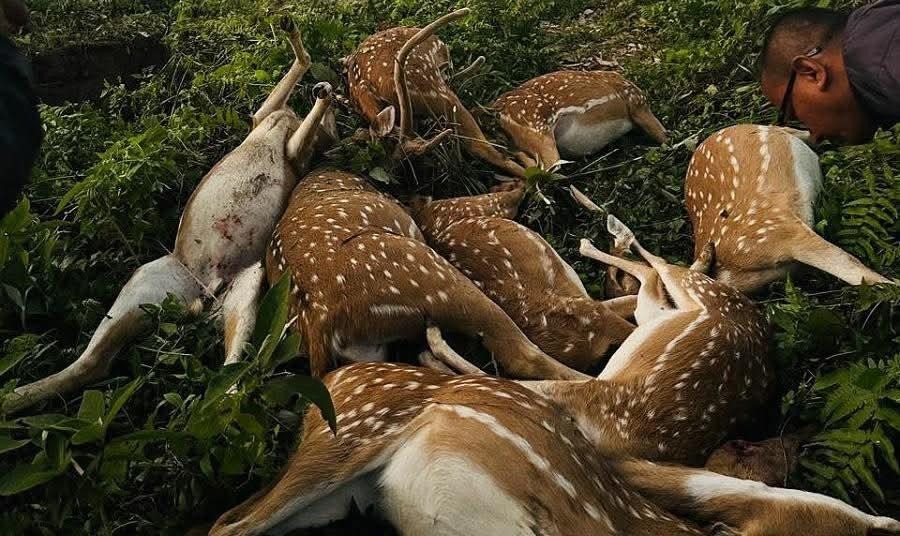
Credit. Abhinash Thapa
Mustard Crops: A Hidden Hazard for Wildlife
During the winter season, particularly in December, mustard fields dominate the agricultural landscape of Nawalpur. These plants, although widely cultivated and essential for local livelihoods, are known to accumulate high levels of nitrates and glucosinolate-derived toxins-substances that can become dangerous for herbivores when consumed in large amounts.
In cold winter conditions, the concentration of these compounds rises, making mustard an even higher-risk forage for deer.
Role of Fertilizer in Increasing Toxicity
Compounding the issue is the heavy use of chemical fertilizers such as urea and other nitrogen-rich inputs commonly applied to mustard crops. These fertilizers significantly increase nitrate accumulation in plant tissues. When wild herbivores graze on such heavily fertilized mustard fields, they are exposed to dangerous nitrate levels, which can rapidly lead to methemoglobinemia, oxygen deprivation, and sudden mortality.
This combination of natural plant toxicity and fertilizer-induced nitrate load may have created an ecological trap for the deer, leading to toxicity level.
A Reflection of Larger Ecological Pressures
This mortality event reflects a broader pattern: shrinking grasslands, seasonal scarcity of natural forage, and increasing agricultural expansion are driving wild herbivores into croplands. As natural food availability declines in winter, deer and other ungulates turn to high-density mustard fields along forest edges, unaware of the hidden chemical and plant-based risks.
Beyond the immediate incident, this raises concerns about habitat fragmentation, climate-induced forage shifts, and the subtle ways in which agriculture influences wildlife health.
Need for Coordinated Conservation Action
The loss of eight spotted deer is not merely an isolated tragedy- it is a warning about the fragility of human–wildlife coexistence. Wildlife conservation today requires a holistic understanding of the interconnectedness between agriculture, forest health, and animal behavior. As the National Park awaits toxicology confirmations, this incident underscores the urgency of integrated land-use planning that protects biodiversity while supporting local communities.