

When the monsoon arrives across the hills and plains of Nepal, actual working farmers face a familiar crisis: severe shortages of chemical fertilizers, unmanaged irrigation channels, and an inability to afford quality seed kits. Yet, on state balance sheets, billions of rupees in agricultural subsidies are disbursed annually to resolve these exact bottlenecks.
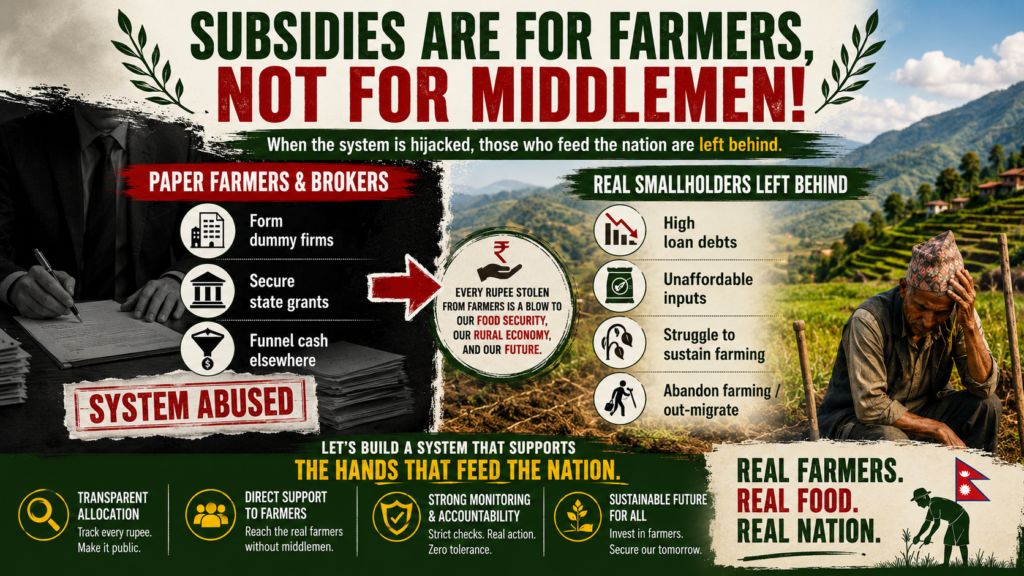
This stark disconnect between massive state expenditure and stagnant rural output points to a systemic flaw: The “Paper Farmers” Scandal (Kagaji Krishak). Across the country, a significant portion of agricultural aid is captured by politically connected individuals, dummy cooperatives, and shell companies that exist solely on official paper. While working smallholders struggle without support, these paper enterprises collect state funds, leaving fields uncultivated.
| Rs 197B+ | > 70% | 14% |
| Disbursed in farm aid over the last decade (OAG Audit) | Subsidy funds diverted in provincial grant probes | Concessional ag-loans diverted to real estate / stocks |
The Proposal-Based Loophole: How the Racket Operates
The structural vulnerability in Nepal’s agricultural grant architecture stems from its reliance on proposal-based evaluation rather than output-based verification.
When municipal or provincial agricultural ministries issue calls for commercial farming grants, smallholders—who often lack formal documentation, administrative literacy, or direct access to municipal offices—are largely left out. In contrast, local political cadres and commercial brokers register private entities or dummy cooperatives (Kagaji Samiti).
These paper firms submit inflated budget proposals, present rented plots or photos of neighboring properties as their own assets, and secure approvals through local selection committees. Once grant funds land in bank accounts, project sites are abandoned, equipment is resold, or money is funneled into non-agricultural ventures such as real estate, hospitality, or riverbed processing plants.
Key Institutional Findings & CIAA Anti-Graft Cases
- Over Rs 197 Billion Spent: Data from the Office of the Auditor General (OAG) shows that between FY 2015/16 and FY 2024/25, federal and provincial bodies disbursed nearly Rs 197 billion in farm-related subsidies. Despite this cash injection, national imports of basic agricultural produce continue to rise annually.
- The 70% Misappropriation Benchmark: A parliamentary investigation led by the Lumbini Provincial Assembly into a Rs 500 million grant program concluded that over 70% of the allocated funds were diverted by non-farmer applicants and colluding local officers.
- Concessional Credit Misuse: A study by Nepal Rastra Bank (NRB) indicated that approximately 14% of low-interest agricultural loans provided by commercial banks were diverted away from farming into personal real estate holdings or stock market trading.
| ⚖️ High-Profile Special Court Filings by the CIAA 1. Madhes Province Shell Farm Case: The CIAA filed charges against senior provincial ministry officials, including former Provincial Secretary Dr. Namrata Singh, for illegally awarding a Rs 14.78 million grant to Yuwarani Fishery and Agricultural Farm Pvt. Ltd., an entity that utilized forged receipts and failed basic operational checks. 2. Lumbini Cold Storage Scam: The anti-graft body indicted 17 individuals – including former Lumbini Provincial Secretary Baikuntha Adhikari—over a Rs 543.79 million cold storage initiative. Investigators verified that Rs 7.19 million was released using falsified progress reports and fake measurement bills for an incomplete, unusable facility. |
Ground-Level Consequences for Nepal’s Countryside
- Rampant Indebtedness: Denied state aid, genuine smallholders rely on informal, high-interest loans from local moneylenders to purchase basic equipment and seeds.
- Accelerated Rural Out-Migration: Unmitigated input costs and market risks force young workers to abandon unviable holdings, accelerating youth out-migration to foreign employment markets.
- Food Security Dependency: Declining domestic production capacity leaves Nepal increasingly dependent on neighboring markets for daily food supply.
Three Pillars for Policy Reform
- Digital Farmer ID & GIS Verification: Mandate that all grant applicants possess a verified digital profile mapped to their land via satellite imagery before any proposal is evaluated.
- Direct Benefit Transfer (DBT): Eliminate intermediate committees and cooperatives by transferring subsidy allocations directly to verified bank accounts held by genuine cultivators.
- Public Audits at Ward Offices: Publish the names, allocated amounts, and verified field locations of all grant recipients on public notice boards at local Ward Offices for community oversight.
“Agriculture cannot grow on paper. Until state resources reach the hands that touch the soil, public funds will continue to vanish—leaving Nepal’s fields emptier with every passing season.”
References & Verified Links
1. Kathmandu Post: Delayed paperwork freezes Rs 60m of farmers’ subsidy
https://kathmandupost.com/money/2022/08/07/delayed-paperwork-freezes-rs60-m-of-farmers-subsidy
2. myRepublica: CIAA files graft case over Rs 7.19m cold storage scam
https://myrepublica.nagariknetwork.com/news/ciaa-files-graft-case-over-rs-719m-cold-storage-scam-10-68.html
3. Kantipur News: Corruption case against 17 including former secretary of Lumbini Province
https://ekantipur.com/news/2026/04/15/en/corruption-case-against-17-including-the-then-secretary-of-lumbini-province-rs-72-million-in-damages-claimed-04-55.html
4. Hamro Patro / CIAA Filings: CIAA files case against ex-secretary Singh, seven others
https://www.hamropatro.com/en/news/detail/12765833508106046-ciaa-files-case-against-ex-secretary-singh-seven-others