Introduction
With its diversified climatic conditions and topography, Nepal is one of those countries that are rich in biodiversity, thereby providing a home for a wide range of agricultural biodiversity, also referred to as agrobiodiversity. Agrobiodiodiversity concerns the diversity of crops, livestock, and microbial diversity on which sustainable agriculture is based. It is critically important for sustaining livelihoods, food security as well as ecosystem resilience. The diverse agro-climatic zones of Nepal enable a wide range of agricultural practices. More than 200 species of crops, including indigenous varieties of rice, maize, millet, and vegetables, exist in the country, according to Shrestha et al. (2014). This diversity supports not only local diets but also enhances resilience against climate change and pest outbreaks (NARC, 2019). Due to the various impacts related to climate change, habitat loss, and globalization, conserving agrobiodiversity has become very important in efforts toward food security and sustainable development in Nepal. The preservation of traditional crops and animal breeds is highly significant in Nepal, as more than 60% of its population is dependent on agriculture for their livelihood. Conservation of traditional agricultural varieties and animal breeds will definitely help to conserve cultural heritage (Poudel et al., 2020). Because of the rich agricultural diversities, different practices of agrobiodiversity conservation have come up. This article looks at some of the practices that exist, how vital they are, and the challenges to realizing these practices.
Conservation Practices
Traditional Farming Practices
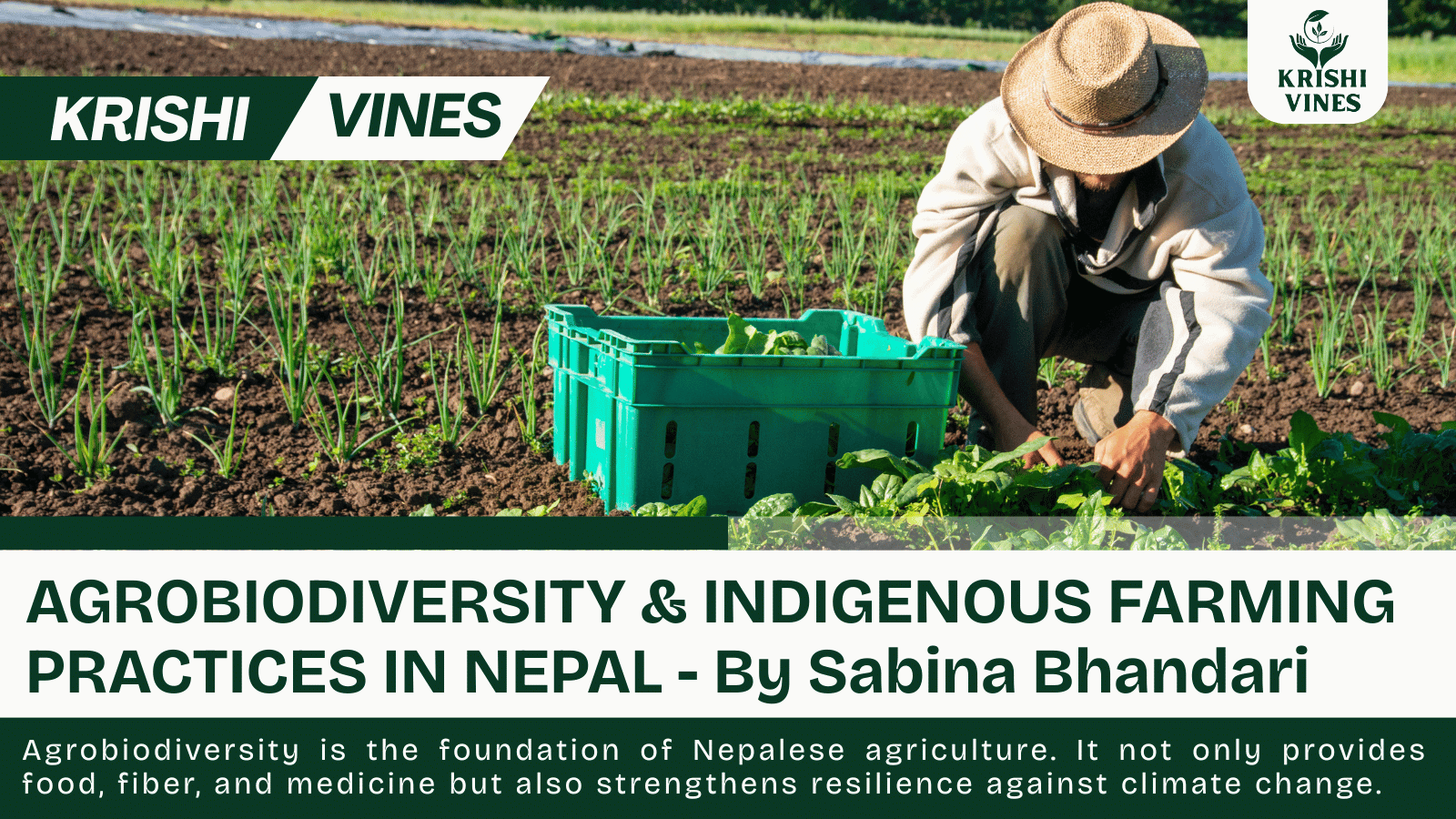
The traditional farming systems are the backbone of agrobiodiversity conservation in Nepal. Traditional crop varieties grown by many farmers are more adapted to their local environments. Most of these are polycultures, enhancing soil health and pest and disease resistance, as described by Gurung (2016). The generationally-passed traditional knowledge is part and parcel of those practices.
Community Seed Banks
Community seed banks have been developed in many areas as one method of preserving local varieties of seeds. The local farmers store and distribute seeds with these seed banks, thus preserving genetic diversity that ensures access to resilient crops for farmers. Community Managed Seed Enterprises initiative has empowered the local communities to take ownership of their seeds (FAO, 2020).
Community Forest Management
Community forest management in Nepal involves local communities in the sustainable management of forest resources. In general, this approach has proved to enhance agrobiodiversity by conserving wild crop relatives and sustainable harvest of non-timber forest products (Khanal et al., 2019). Integration of agriculture into forested landscapes enhances overall biodiversity.
Agroecological Practices
Organic farming – production system that sustains the health of soils, ecosystems, and people; Crop Rotation – rotation of crops in the same area across a sequence of growing seasons and Intercropping – the practice of growing more than one crop in close proximity are the best examples of agroecological practices to improve biodiversity by reducing chemical use and improving soil health which are very common in Nepalese agriculture. The training and support provided under various NGOs and government programs have triggered agroecological approaches amongst farmers, which have eventually contributed to ecosystem services for improved livelihoods (Subedi et al., 2021).
Participatory Plant Breeding
Participatory plant breeding involves farmers in selecting and breeding crop varieties adapted to their respective environments. Besides conserving the genetic resources at the local level, this approach can also make the communities more resilient to altered climatic conditions. Various projects in different parts of Nepal have been able to demonstrate that farmer involvement in breeding can yield results in developing climate-resilient crop varieties.
Policy and Institutional Support
The Government of Nepal has recognized the importance of agrobiodiversity and formulated policies for its conservation. The National Agricultural Policy and the National Biodiversity Strategy and Action Plan present the frameworks for integrating agricultural development with the conservation of agrobiodiversity (MoALD, 2015). Besides, collaborative initiatives with international organizations, such as the FAO and IUCN, have also been strengthened.
Education and Awareness Programs
The importance of agrobiodiversity needs to be made known to the people for its conservation. Various NGOs and community-based organizations organize workshops and training for farmers about the benefits of biodiversity maintenance. Such education programs highlight that agrobiodiversity is interlinked with sustainable agriculture and food security (Bhandari et al., 2019).
Challenges to Agrobiodiversity Conservation
Despite these, a number of obstacles persist in the way of agrobiodiversity conservation in Nepal. Some of the serious ones include:
Market Pressures: Increasing demand for high-yielding varieties often leads to the abandonment of indigenous crops and species and further threatens their survival.
Climate Change: Traditional crops and livestock have become threatened due to changing rainfall patterns and increasing temperatures related to climate change (Paudel et al., 2019). Improved climatic changes already take a toll on crop yield and biodiversity; hence, urgent adaptation strategies are required.
Migration and Urbanization: Rural-urban migration is one of the factors causing loss of traditional knowledge concerning agriculture and hence poses more threats to the local biodiversity. The rapid expansion of cities and infrastructures in vast areas of Nepal means a shift in agricultural lands to suit such development needs, hence posing threats to traditional farming systems and available local biodiversity.
Conclusion
Agrobiodiversity is crucial for food security and sustainable development in Nepal. This type of integration by traditional practices, community efforts, and policies will surely provide a strong framework for agricultural diversity conservation. The challenges posed by market forces, climate change, and social transformations require the sustainability of these initiatives over the long haul. Government agencies, NGOs, and local communities should all work together to create a resilient agriculture future for Nepal. Much more efforts are required to be made to overcome the challenges agrobiodiversity is facing and to save this rich agricultural heritage.
References
Bhandari, S., Thapa, G. B., & Regmi, B. (2019). Understanding the role of community seed banks in promoting agrobiodiversity in Nepal. Journal of Agriculture and Environment for International Development, 113(2), 147-159.
FAO. 2020. Community Managed Seed Enterprises: A Guide for Action. Food and Agriculture Organization of the United Nations.
Gurung, G. (2016). The Contribution of Traditional Agricultural Practices to Agrobiodiversity Conservation in Nepal. Nepal Journal of Science and Technology, 17(1), 29-34.
MoALD. (2015). National Agricultural Policy. Ministry of Agriculture and Livestock Development, Nepal.
NARC. 2019. National Agricultural Research Council Annual Report 2018-2019. National Agricultural Research Council, Nepal.
Shrestha, J., Ranjitkar, S., & Bhandari, B. 2014. Agrobiodiversity in Nepal: Current Status and Future Prospects. Journal of Biodiversity and Environmental Sciences, 5(4): 1-10.
Subedi, A., Pant, K. P., & Thapa, B. 2021. Promoting Agroecological Practices for Sustainable Agriculture in Nepal. International Journal of Agriculture and Environmental Research, 7(2): 85-98.
Khanal S.N. et al. 2019. Community forest management and agrobiodiversity in Nepal: A Case Study. *Forest Ecology and Management*, Vol 455, 117679.
Paudel, P. K., et al. 2019. “Impacts of Climate Change on Traditional Crop Varieties in Nepal.” Environmental Science & Policy 93: 207-218.
Poudel, R., et al. 2020. “Agrobiodiversity for Food Security in Nepal.” Agriculture and Food Security 9(1): 1-14.