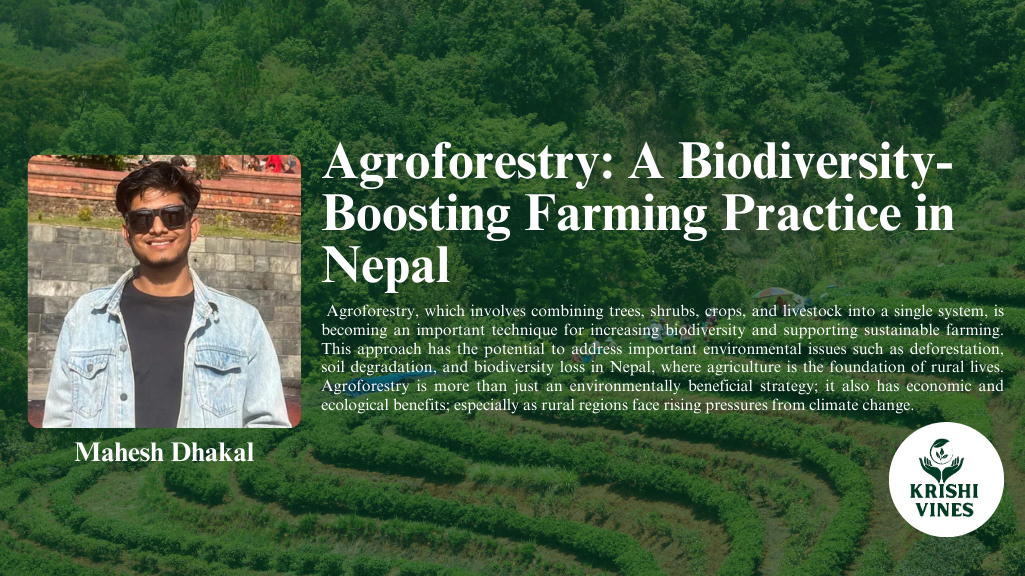
Agroforestry, which involves combining trees, shrubs, crops, and livestock into a single system, is becoming an important technique for increasing biodiversity and supporting sustainable farming. This approach has the potential to address important environmental issues such as deforestation, soil degradation, and biodiversity loss in Nepal, where agriculture is the foundation of rural lives. Agroforestry is more than just an environmentally beneficial strategy; it also has economic and ecological benefits; especially as rural regions face rising pressures from climate change.
The Role of Agroforestry in Biodiversity Conservation:
Agroforestry is ideal for biodiversity conservation because it can develop different habitats that resemble natural ecosystems. Traditional agroforestry techniques have long been a part of Nepal’s agricultural systems, particularly in the mid-hills where trees, crops, and cattle are farmed together. Along with improving soil health and offering other ecosystem services, the integration of different plant species in agroforestry systems supports a variety of fauna, such as insects, birds, and mammals. Research indicates that agroforestry systems can sustain greater biodiversity than monoculture agricultural systems, which are frequently harmful to the health of ecosystems (Pandit et al., 2020). Agroforestry techniques that plant fruit trees like mango (Mangifera indica), litchi (Litchi chinensis), and fodder species like Ficus semicordata alongside staple crops like maize and millet have been successful in preserving biodiversity in Nepal’s mid-hills. These systems provide habitat for a range of species, improving pollination and natural pest control, as well as maintaining soil fertility through leaf litter decomposition and root systems that prevent erosion. A nitrogen-fixing tree that is frequently employed in agroforestry systems is Leucaena leucocephala, which enhances soil fertility and lowers the demand for artificial fertilizers, promoting a more sustainable farming system (Thapa et al., 2022). Agroforestry can also play an important role in preserving Nepal’s indigenous species. Taxus wallichiana, an endangered tree known for its medicinal characteristics, has been protected from overharvesting in natural forests through agroforestry systems (Paudel & Subedi, 2019). The incorporation of natural and economically valuable species into agricultural landscapes demonstrates agroforestry’s potential for biodiversity protection.
Agroforestry as a Climate-Resilient Strategy:
The effects of climate change, such as unpredictable rainfall, soil erosion, and decreased soil fertility, are especially dangerous for Nepal’s farming community. By improving soil stability, increasing water retention, and establishing a microclimate that protects crops from harsh weather, agroforestry provides a resilient option. It has been demonstrated that agroforestry systems in the mid-hill and Terai regions that combine trees like Albizia julibrissin with crops like millet and maize increase resistance to climate variability (Amatya & Cedamon, 2017). The use of nitrogen-fixing trees in agroforestry systems promotes climate resilience by enhancing soil health and minimizing the requirement for synthetic fertilizers. A more sustainable and climate-resilient farming system is encouraged by the organic matter that is added to the soil by the decomposition of leaf litter from species such as Leucaena leucocephala. Agroforestry systems’ trees also function as carbon sinks, absorbing carbon from the atmosphere reducing the effects of climate change. According to a study published by ICIMOD (2018), agroforestry systems in Nepal have the potential to sequester up to 9.7 tons of carbon per hectare per year, making them an essential tool for climate mitigation and adaptation.
Economic and Social Benefits:
Agroforestry not only benefits the environment but also offers major economic benefits to farmers. Farmers who diversify their revenue sources by selling timber, fruits, fodder, and non-timber forest products can lessen their reliance on a single crop and become more resilient to market swings. Agroforestry systems have been demonstrated to enhance soil health in areas where deforestation has resulted in soil degradation and decreased crop yields, increasing agricultural output and lowering poverty among smallholder farmers (Bista et al., 2020).
Fruit trees like Artocarpus heterophyllus (jackfruit) and Mangifera indica are used in agroforestry in the Terai region, where farmers have reported increased profits from the selling of both timber and fruits. While using fodder trees like Ficus religiosa lowers the cost of feeding animals, integrating livestock into agroforestry systems also offers an extra revenue stream through the sale of milk and meat (Gurung et al., 2021). This diversification of revenue sources not only increases the economic stability of agricultural households, but it also helps with food security and rural development.
Challenges in Agroforestry Adoption:
Despite its various benefits, broad adoption of agroforestry in Nepal confronts a number of hurdles. The absence of clear regulations and incentives to support agroforestry methods is one of the primary challenges. In its National Agroforestry Policy (2019), the government acknowledged the promise of agroforestry; but, due to a lack of financing, technical assistance, and farmer awareness, implementation has been sluggish (MoALD, 2020). Additionally, smallholder farmers find it challenging to deploy agroforestry systems on a wide scale due to fragmented landholding patterns, especially in the mid-hills (Thapa et al., 2022). The lack of programs for training farmers and the restricted availability of high-quality planting materials presents further difficulties. There is a lack of nurseries offering high-quality tree seedlings, and many farmers are not aware of the methods required to successfully incorporate trees into their agricultural systems (Paudel & Subedi, 2019). Governmental institutions, non-governmental organizations (NGOs), and the corporate sector must work together to overcome these obstacles and offer financial and technical assistance for the adoption of agroforestry.
Conclusion:
Agroforestry has enormous potential for biodiversity conservation and sustainable farming in Nepal. Nepal can address its environmental concerns and improve the livelihoods of its farming communities by combining traditional knowledge with modern agroecological approaches. In order to scale up agroforestry methods and guarantee the long-term viability of Nepal’s agricultural landscapes, strengthening policy frameworks, improving farmer training programs, and improving access to planting materials are essential measures.
References:
Pandit, A., et al. (2020). “Agroforestry practices for biodiversity conservation in Nepal.” Journal of Sustainable Agriculture, 45(4), 210-225.
Thapa, S., et al. (2022). “Role of nitrogen-fixing trees in enhancing soil fertility in agroforestry systems.” Nepalese Journal of Agricultural Sciences, 18, 321-336.
ICIMOD (2018). “Potential of agroforestry systems for carbon sequestration in Nepal.” International Centre for Integrated Mountain Development Report.
Bista, R., et al. (2020). “Economic benefits of agroforestry systems in Nepal’s Terai region.” Agroforestry and Sustainable Development, 14(3), 109-120.
Gurung, J., et al. (2021). “Integration of livestock in agroforestry systems in Nepal.” Journal of Livestock Science, 12(2), 56-67.
Paudel, P., & Subedi, N. (2019). “Conservation of endangered species through agroforestry in Nepal.” Environmental Conservation, 46(2), 183-195.