Introduction
Nepal relies heavily on agriculture, with more than 60% of its population depending on farming. The majority practice rain-fed agriculture, which is particularly vulnerable to climate change. Recent shifts in weather, such as inconsistent rainfall and more frequent flash floods, are beginning to disrupt traditional farming methods (Ministry of Agriculture Development, 2019; ICIMOD, 2021).
These changes not only lead to immediate losses in crop yields but also negatively impact soil quality and water resources, making farming increasingly difficult (Khadka et al., 2020). Farmers are encountering a range of challenges, including lower crop outputs, rising pest problems, and uncertainty around planting and harvest timings. To cope with these issues, many are turning to various adaptation strategies, such as diversifying their crops, enhancing water management practices, and using climate-resilient seed varieties. Additionally, community initiatives and government support are being introduced to help farmers tackle these challenges, emphasizing the importance of sustainable methods that can endure climate fluctuations (Thapa et al., 2021).
This paper will explore how climate change—particularly the unpredictability of rainfall and the increase in flash floods—affects rain-fed agriculture in Nepal, the difficulties faced by farmers, and the adaptive strategies they are employing to address these issues.
.Rain-Fed Agriculture and Its Importance in Nepal
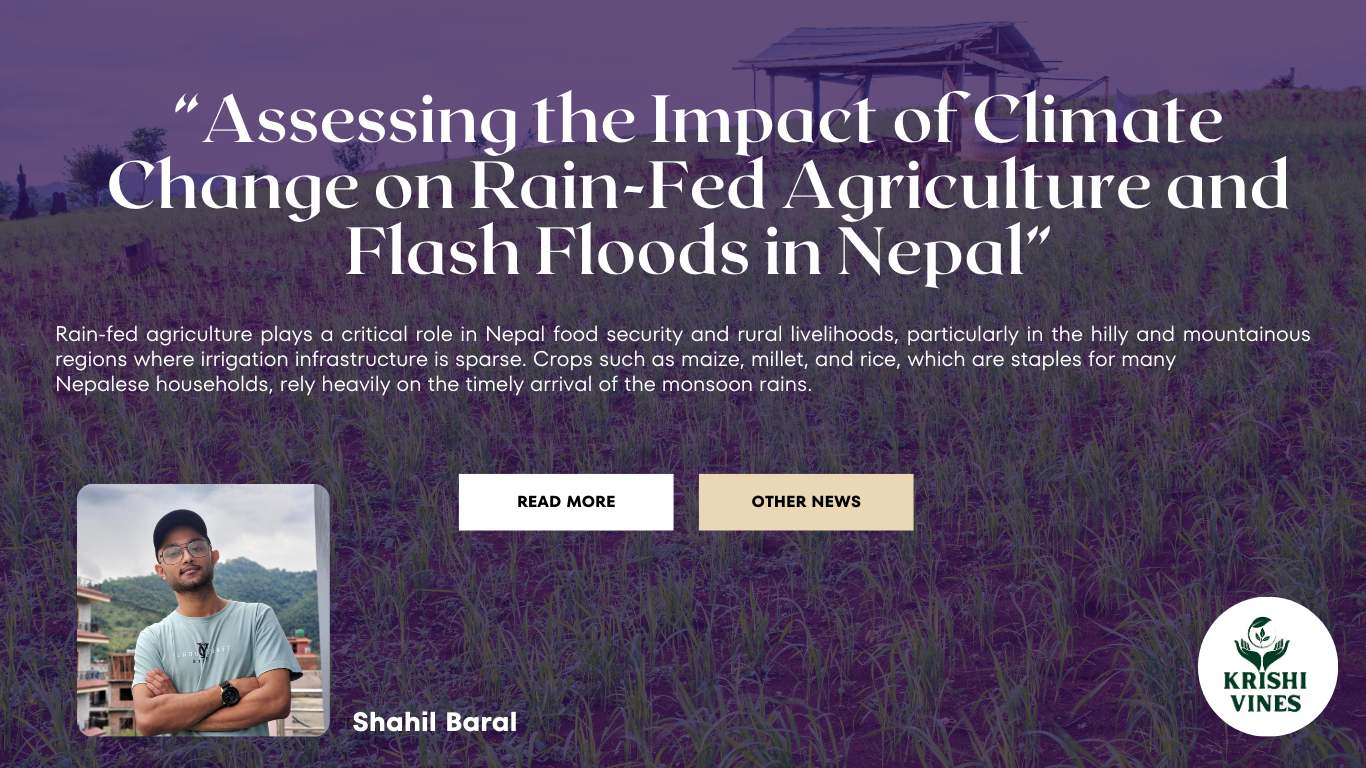
Rain-fed agriculture plays a critical role in Nepal’s food security and rural livelihoods, particularly in the hilly and mountainous regions where irrigation infrastructure is sparse (Practical Action, 2017). Crops such as maize, millet, and rice, which are staples for many Nepalese households, rely heavily on the timely arrival of the monsoon rains (MOAD, 2019). Any variation in the rainfall pattern can result in significant crop losses, making rain-fed farming particularly vulnerable to climate-induced challenges.

Figure 1: Ropai (rice planting) on the monsoon time I.e. June
Climate Change and Erratic Rainfall Patterns
Nepal has experienced notable changes in its climate over recent decades. Monsoon rains have become increasingly erratic, with delays in onset, uneven distribution, and, in some cases, extreme rainfall events occurring within short periods (Karki et al., 2024). These changes disrupt traditional farming cycles, making it difficult for farmers to plan their planting and harvesting schedules (MDPI, 2024). Farmers, especially in the rain-fed regions, depend on the monsoon rains arriving on time to ensure a successful harvest, and any disruption in rainfall can result in reduced yields or even crop failure (FAO, 2021).
Moreover, excessive rainfall during critical growth periods can cause waterlogging, damaging crops like rice, which are typically cultivated in standing water but cannot tolerate prolonged saturation (Dahal & Shrestha, 2020). This unpredictability is pushing many farmers to adopt riskier farming strategies, further increasing their vulnerability (ICIMOD, 2021).

Figure 2: The spatial distribution of average seasonal precipitation (mm) is represented for four distinct periods: (a) pre-monsoon, (b) monsoon, (c) post-monsoon, and (d) winter, covering the years 1981 to 2010. It is important to note that the legend scales for
Flash Floods: An Emerging Threat to Agriculture
The increased frequency of flash floods, often triggered by intense monsoon downpours, presents another significant threat to Nepal’s agricultural landscape (Poudel & Shaw, 2022). Flash floods cause extensive damage to crops, destroy irrigation systems, and accelerate soil erosion, depleting the fertility of the land. In areas like the Terai region, flash floods also lead to waterlogging, rendering land unusable for the rest of the growing season (Practical Action, 2017).
In hilly regions, flash floods often trigger landslides, which cause further destruction by burying fertile farmland under layers of debris (Shrestha, 2020). The combination of soil erosion and loss of arable land from these extreme events is diminishing the overall productivity of Nepal’s agricultural sector, threatening food security (Karki et al., 2024).

Figure 3:. The impact of climate change on rain-fed agriculture in Nepal
Adaptation Strategies for Climate-Resilient Agriculture
Despite these challenges, farmers in Nepal have begun to adapt through a range of strategies designed to build resilience to climate-induced risks. Among the most effective strategies is the diversification of crops. Farmers are moving away from water-intensive crops like rice and opting for drought-resistant varieties such as millet, barley, and legumes, which can better withstand erratic rainfall and dry spells (MOAD, 2019).
In addition to crop diversification, improved water management practices are being adopted. Rainwater harvesting, the use of water-efficient technologies, and small-scale irrigation systems are helping farmers reduce their dependence on unpredictable rainfall and improve crop productivity during dry spells (FAO, 2021). These systems also offer protection against the risks posed by flash floods, as better water control allows farmers to prevent waterlogging and the destruction of their crops (Karki et al., 2024).
Soil conservation practices such as terracing, mulching, and agroforestry are also gaining popularity as ways to combat soil erosion caused by flash floods and heavy rains. These methods help maintain soil fertility and reduce the risk of landslides in mountainous areas, preserving farmland for future agricultural use (Practical Action, 2017).

Source: My Republica, 2022
Figure 5: Farmers Implementing Climate-Smart Agricultural Practices i.e. mixed cropping
Government and Policy Interventions
The government of Nepal, in collaboration with international organizations, has initiated several programs aimed at promoting climate-resilient agriculture. Policies such as the National Adaptation Programme of Action (NAPA) and the Climate Change Policy 2019 focus on improving irrigation infrastructure, promoting climate-resilient crops, and providing financial support to farmers impacted by climate-induced disasters (MOAD, 2019). However, the implementation of these policies remains a challenge due to limited resources and the difficult terrain in rural areas, which restricts access to information and technology for many farmers (Shrestha, 2020).
There is also a need for greater awareness and education about the impacts of climate change, as many farmers are still unfamiliar with modern adaptation techniques and rely on traditional farming methods that may no longer be effective under changing climate conditions (Karki et al., 2024).
Conclusion
Climate change poses a severe threat to Nepal’s rain-fed agriculture, with erratic rainfall patterns and flash floods creating significant challenges for farmers. The unpredictability of the monsoon season disrupts farming schedules, reduces crop yields, and increases the risk of crop failure. Flash floods further exacerbate these challenges by destroying crops and causing soil erosion. However, through the adoption of resilient farming practices such as crop diversification, improved water management, and soil conservation techniques, farmers are gradually building their capacity to cope with the impacts of climate change. Continued government support and investment in climate-resilient infrastructure will be crucial in ensuring the long-term sustainability of Nepal’s agricultural sector.
References
Dahal, R., & Shrestha, M. (2020). The impacts of erratic rainfall on agricultural productivity in the Kathmandu Valley. Journal of Agriculture and Environmental Science, 8(2), 123-137. https://doi.org/10.1007/s10584-020-02877-9
Food and Agriculture Organization (FAO). (2021). Climate-smart agriculture in Nepal: Building resilience for farmers. http://www.fao.org/nepal
International Centre for Integrated Mountain Development (ICIMOD). (2021). Assessing and addressing climate-induced loss and damage in Nepal. https://lib.icimod.org/record/35313/files/HimalDoc2021_WorkingPaper_AssessingAndAddressingClimate-inducedLossAndDamageInNepal_PracticalAction.pdf
Karki, R., Jakubínský, J., & Shrestha, S. (2024). Sustainable farming in Nepal under changing climate conditions: A case study of Dolakha district. Land, 13(10), 1610. https://doi.org/10.3390/land13101610
Ministry of Agriculture Development (MOAD). (2019). National Adaptation Programme of Action for Climate Change in Nepal. Kathmandu: Government of Nepal.
Poudel, K., & Shaw, R. (2022). Flash floods and their impacts on agriculture in Nepal: Adaptation strategies for resilience. International Journal of Disaster Risk Science, 13(1), 98-110.
Practical Action. (2017). Building climate resilience in Nepal’s farming communities. https://practicalaction.org
Khabarhub. (2021, September 26). Climate change affecting agriculture in Nepal. https://english.khabarhub.com/2021/26/216625/
Khanal, U., & Ghimire, B. (2020). Impact of Climate Change on Rain-Fed Agriculture in Nepal: A Case Study of Ramechhap District. Agriculture, 5(1), 4. https://doi.org/10.3390/agriculture5010004
Bista, R. (2020, December 21). The importance of agriculture cannot be reinforced more effectively than during a pandemic. Online Khabar. https://english.onlinekhabar.com/importance-of-agriculture-cant-be-reinforced-more-effectively-than-in-pandemic.html
Khadka, A., Shrestha, M., & Devkota, A. (2020). Impact of climate change on agricultural productivity in Nepal: A review. Journal of Agricultural Science and Technology, 22(3), 345-360.
Thapa, S., Bhandari, R., & Ghimire, S. (2021). Community-based adaptation strategies to climate change in Nepal: Opportunities and challenges. Climate Policy, 21(4), 450-465.
My Republica. (2022, March 28). Farmers adopt climate-smart agriculture. Retrieved from https://myrepublica.nagariknetwork.com/news/farmers-adopt-climate-smart-agriculture/