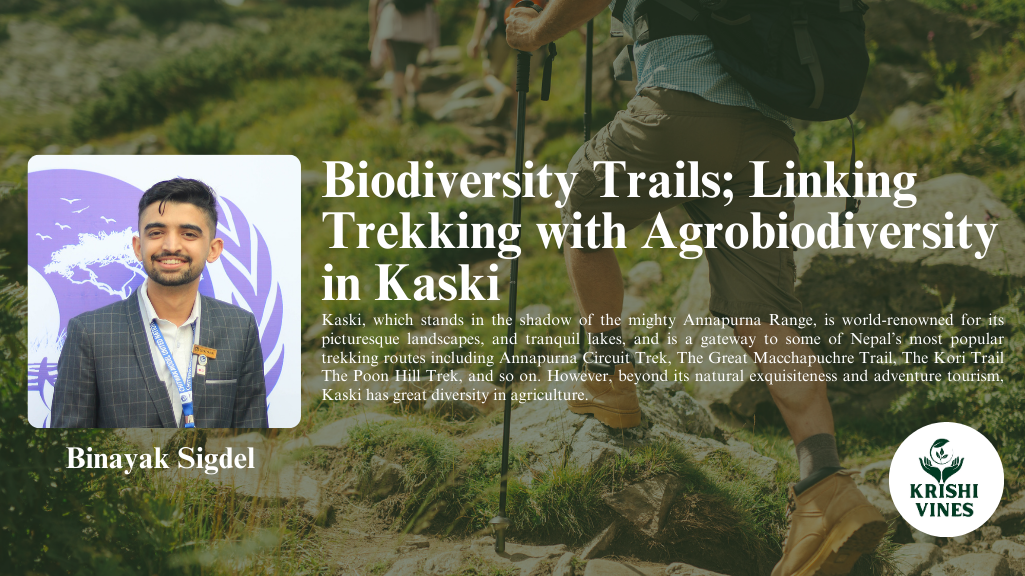
Kaski, which stands in the shadow of the mighty Annapurna Range, is world-renowned for its picturesque landscapes, and tranquil lakes, and is a gateway to some of Nepal’s most popular trekking routes including Annapurna Circuit Trek, The Great Macchapuchre Trail, The Kori Trail The Poon Hill Trek, and so on. However, beyond its natural exquisiteness and adventure tourism, Kaski has great diversity in agriculture. Pokhara is the number one adventure and leisure city (Adhikari, 2019) . The local communities practice traditional farming methods that preserve indigenous crop varieties and livestock breeds. This perfect blend of cultural and biological diversity presents an exciting opportunity for creating “Biodiversity Trails”—trekking routes showcasing the region’s unique agrobiodiversity while providing immersive experiences for eco-conscious travelers. Good coordination of Pokhara Metropolitan City with the four Rural Municipalities i.e. Rupa, Madi, Annapurna, and Macchapuchre can ensure this blissful and very captivating experience for all the national and international backpackers (Khatiwada et al., 2021) .
The Concept of Biodiversity Trails
“It’s not the destination, it’s the journey.” – Ralph Waldo Emerson. It’s also about the process of discovery – noticing how the species adapt, witnessing seasonal changes, and newer agricultural practices, or seeing how vague is the biodiversity. A pleasure for the eyes and delving into nature to provide pleasure to the mind is Biodiversity Trail.
Biodiversity Trails are one of the tourisms that integrates tourism trekking and hiking in particular with education on local ecological and agricultural diversity. This popular concept has been used by several universities to teach their student but can be integrated on a larger scale for such diverse trekking trails. As the trekkers pass the hills, valleys, and rural settlements around the Pokhara, they encounter not only breathtaking landscapes but also a wide variety of crops, farming systems, and diverse agricultural practices (Joshi et al., 2020) . These trails can provide ideas for sustainable practices of local communities to cultivate diverse plant species suited to the region’s microclimates and geographic conditions. With fertile valleys and diverse ecological zones, Kaski has remarkable assortments in agrobiodiversity. One can experience the terraces of indigenous rice varieties in lower elevations to barley, millet, buckwheat, potato, and many organic vegetables considered off-seasonal to the popular markets in the higher altitudes. Moreover, the trees and shrubs specific to the locations also hold an indigenous importance..
Linking Trekking with Agrobiodiversity
All the trekking trails around the Kaski pass through numerous rural villages where agriculture remains the primary livelihood which is not yet commercialized. By incorporating agrobiodiversity as a central theme of these routes, tourists can gain a deeper understanding of the region’s agricultural practices (Bam, 2023) . Organic farms, community seed banks, traditional irrigation and harvesting systems, and learning them firsthand would give a remarkable experience and insights about agrobiodiversity and can generate a handsome amount for the locals.
For example, the Pokhreli Jethobudo, the rice of aroma and flavor, Chhomrong Dhan, and Pahele Dhan are well adapted to the regions where the trails pass. Similarly, they could visit farms that grow traditional vegetables and medicinal plants, contributing to both local diets and health. In Madi Rural Municipality, 02-Sikles, en route to Kapuche Lake and Kori there is a community museum that reflects the indigenous traditions, tools, and practices. These kinds of experiences would not only connect tourists with the region’s agrobiodiversity but also support local farmers who are engaged in conserving these genetic resources (Upreti et al., 2013).
For these links to be effectively and efficiently implemented and publicized, concerned authorities i.e. Nepal Tourism Board (NTB), Annapurna Conservation Area Project (ACAP), rural municipalities and metropolitan city authorities, certified guides, tours and travel agencies, Trekkers Information Management Systems (TIMS) and so on should work collaboratively to research and publish various works of literature related to biodiversity trails and circulate via several physical and virtual means. Moreover, these pieces of information can be provided before the trekking through classes, media, and online platforms, and during the trek through posters and boards.
Benefits of Biodiversity Trails
The prime motivation of the Biodiversity Trail is they further the causes of sustainable tourism. the tourists will be presented not just with the scenic wraps of nature but also the insights of environment, sustainability, and cultural interactions. Moreover, this kind of tourism enables rural people to improve their incomes without exerting additional pressure on the environment. People may start conserving the resources given that they also become aware about the importance of native species and traditional forms of agriculture. These trails also present an alternative form of ecotourism emphasizing the significance of people-environment interaction, particularly how local communities have shaped and been shaped by their intensive forms of agriculture. This peculiar specification can enhance the trekking experience whereby visitors receive an integrated approach to the region’s ecosystem and its components.
Supporting local farmers and agrobiodiversity conservation biodiversity trails directly benefit the local farmers. The farmers can involve the tourists in farm tours, seed exchange programs, and exchange ideas about traditional, modern, and post-modern practices. Moreover, a market is created for different local products, organic ones, medicinal herbs, and traditional products to both domestic and international tourists (Upreti et al., 2013) . This will provide economic incentives for the farmers to continue the cultivation of native varieties and help protect these genetic resources. Similarly, the rapid switch to the hospitality business causing the degradation of forests, barren agricultural lands and import of the products will also come to a halt.
Conclusion
Biodiversity Trails represent a new way of connecting the popular trekking culture of not just Pokhara or Kaski but the entire hilly and mountainous region of Nepal. These trails integrate trekking with education on local agricultural systems, innovations at the local level, traditional knowledge, and conservation. They provide an outstanding opportunity to experience this uniquely for the tourists and provide tangible benefits to the local communities through the development of sustainable tourism. It has the potential ultimately to enhance not only Nepal’s tourism sector but also the invaluable agrobiodiversity of Nepal.
References
Adhikari, S. (2019). PROSPECTS OF TOURISM IN NEPAL A study of Pokhara City Thesis International Business. Prospects of Tourism in Nepal, February, 1–48.
Bam, N. (2023). Analysis of Tourists’ Length of Stay in Pokhara, Nepal. Advances in Hospitality and Tourism Research, 11(1), 28–44. https://doi.org/10.30519/ahtr.1073732
Joshi, B. K., Gorkhali, N. A., Pradhan, N., Ghimire, K. H., Gotame, T. P., KC, P., Mainali, R. P., Karkee, A., & Paneru, R. B. (2020). Agrobiodiversity and its Conservation in Nepal. Journal of Nepal Agricultural Research Council, 6(March), 14–33. https://doi.org/10.3126/jnarc.v6i0.28111
Khatiwada, S. S., Sharma, R., & Ranabhat, S. (2021). Impact of Covid-19 on Tourism Business in Pokhara Nepal. Janapriya Journal of Interdisciplinary Studies, 10(01), 125–139. https://doi.org/10.3126/jjis.v10i01.42617
Upreti, B. R., Upadhayaya, P. K., & Sapkota, T. (2013). Tourism in Pokhara, Issues, Trends and Future Prospects for Peace and Prosperity (Issue July).