


Article
The article categories in an agriculture website encompass a wide range of topics relevant to the agricultural industry. These categories often cover areas such as crop cultivation techniques, livestock management, agricultural machinery and technology, organic farming practices, soil health and fertility, pest and disease management, agricultural economics and markets, agricultural policy and regulations, sustainable agriculture, climate-smart farming, and agricultural research and innovation. These categories serve as a repository of valuable information and resources for farmers, agronomists, researchers, and individuals interested in various aspects of agriculture.
Understanding Precision Agriculture: A Comprehensive Guide to Its Functionality and Benefits – By Aakash Thapa Tamang || Krishi Vines
1. Introduction to Precision Agriculture 1.1 Definition and Overview Precision agriculture, often referred to as precision farming, is an innovative approach that utilizes technology to monitor and manage field variability in crops. This method allows farmers to optimize their inputs such as water, fertilizers, and pesticides based on the specific needs of their crops. By…
Water Smart Agriculture: Enhancing resilience for sustainable Farming – By Shanti Kumal || Krishi Vines
In today’s era marked by climate change and water scarcity, the challenge of ensuring food security while protecting our planet’s biodiversity has never been more critical. Water smart-agriculture is emerging as key solution to this dilemma, focusing on efficient water use and promoting practices that supports sustainable ecosystem. This article explores how water smart-agriculture can…
Community Conservation Of Agrobiodiversity In Western Part Of Nepal – By Anushila Khadka || Krishi Vines
Introduction Nepal is renowned for its rich diversity in ecosystems, civilizations and landscapes shaped by its unique geography and cultural heritage. This diversity is also evident in its agricultural systems, where a wide range of crop varieties, livestock breeds, and other biological resources have long been preserved through traditional farming methods. Communities in the western…
Agrobiodiversity Conservation: Farmer-Led Innovations and Practices – By Deepa Gaire || Krishi Vines
Abstract Agrobiodiversity encompasses the variety and variability of plants, animals, and microorganisms used for food, fuel, and fiber. Farmers play a critical role in maintaining this diversity through traditional farming practices and innovations suited to local environments. This research highlights indigenous methods of agrobiodiversity conservation, exploring sustainable farming techniques that preserve diverse crops and livestock…
Urbanization and Climate Change: Its Impact on Local Biodiversity Hotspots – By Monika Thapa Chhetri || Krishi Vines
Abstract Urbanization leads to habitat fragmentation, pollution, and the introduction of invasive species, while climate change exacerbates these challenges through altered temperature and precipitation patterns, extreme weather events, and rising sea levels. Case studies from the Himalayas, Southeast Asia, and Latin America highlight the urgent need for sustainable urban planning, nature-based solutions, and policy interventions…
“Balancing Global Trade and Local Crop Diversity for Sustainable Food Systems” – By Prakash Bhatt || Krishi Vines
Introduction Agrobiodiversity, or agricultural biodiversity, refers to the variety and variability of plants, animals, and microorganisms used for food and agriculture. It includes genetic resources, species diversity, and the diverse ecosystems within which agricultural activities occur. Agrobiodiversity is crucial for resilient food systems, ensuring food security, and enabling adaptation to environmental changes. However, the global…
Role Of Urban Agrobiodiversity In Sustainable City Planning Along With Integration Of Local Varieties – By Barsha Paudel || Krishi Vines
Cities are becoming more and more acknowledged as essential locations for the protection of biodiversity as global urbanization picks up speed. Sustainable cities are largely dependent on urban agrobiodiversity, which is the range of crops, animals, and ecosystems that are a part of urban agriculture. It expresses cultural legacy, increases resistance to environmental problems, improves…

Agrobiodiversity conservation through local innovation and practices in Nepal – By Sulochana Bhandari || Krishi Vines
Introduction In Nepal, the term “agrobiodiversity” refers to the range and diversity of flora, fauna, and microbes that are either directly or indirectly utilized for agriculture, food production, and subsistence. With a geography that varies from the lowland Terai to the Himalayan mountains, Nepal provides a rich and distinctive biodiversity that is conducive to a…
Saving seeds: How Farmer Preserve Agrobiodiversity for the Future – By Sujata Pandey || Krishi Vines
In the face of climate change and mounting food security concerns, an ancient technique is gaining popularity again: seed saving. Farmers have been handing along agricultural legacy from generation to generation for millennia by carefully selecting and preserving seeds from their greatest crops. In addition to guaranteeing a steady supply of food, this age-old custom…
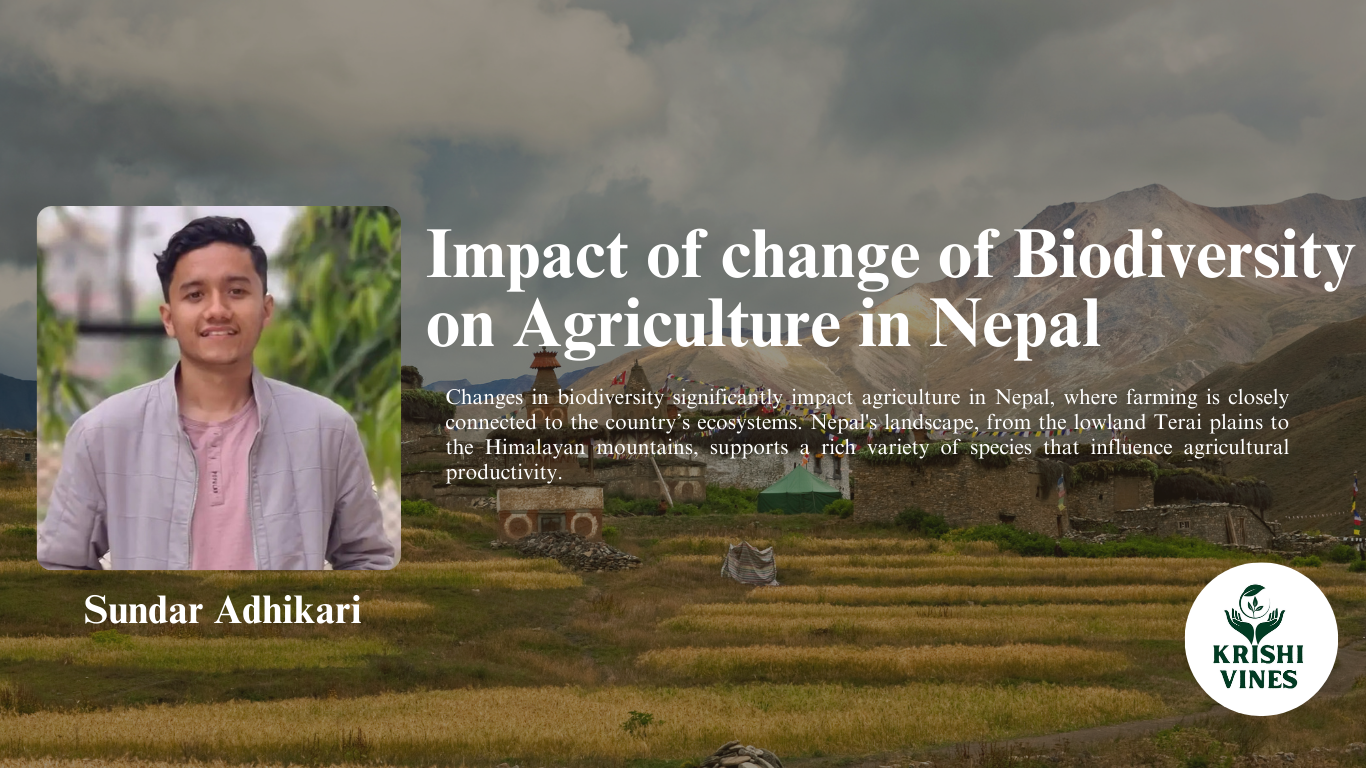
Impact of change of biodiversity on agriculture in Nepal – By Sundar Adhikari || Krishi Vines
Changes in biodiversity significantly impact agriculture in Nepal, where farming is closely connected to the country’s ecosystems. Nepal’s landscape, from the lowland Terai plains to the Himalayan mountains, supports a rich variety of species that influence agricultural productivity. Here’s how shifts in biodiversity affect farming: 1. Decline of Pollinators Pollinators like bees, butterflies, and other…
