


Article
The article categories in an agriculture website encompass a wide range of topics relevant to the agricultural industry. These categories often cover areas such as crop cultivation techniques, livestock management, agricultural machinery and technology, organic farming practices, soil health and fertility, pest and disease management, agricultural economics and markets, agricultural policy and regulations, sustainable agriculture, climate-smart farming, and agricultural research and innovation. These categories serve as a repository of valuable information and resources for farmers, agronomists, researchers, and individuals interested in various aspects of agriculture.
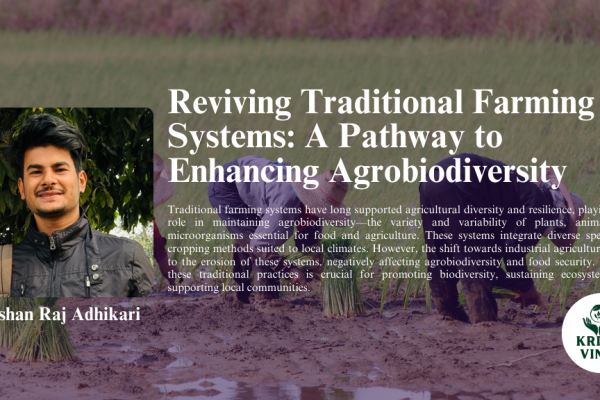
Reviving Traditional Farming Systems: A Pathway to Enhancing Agrobiodiversity – By Poshan Raj Adhikari || Krishi Vines
1. Introduction Traditional farming systems have long supported agricultural diversity and resilience, playing a key role in maintaining agrobiodiversity the variety and variability of plants, animals, and microorganisms essential for food and agriculture. These systems integrate diverse species and cropping methods suited to local climates. However, the shift towards industrial agriculture has led to the…
Climate-Smart Agriculture: A Pathway to Sustainable Food Security – By Mandeep Thapa || Krishi Vines
Introduction Climate-smart agriculture (CSA) is an integrated approach to manage landscapes—cropland, livestock, forests and fisheries-that address the interlinked challenges of food security and climate change. As the impacts of climate change become increasingly evident, the agricultural sector faces unprecedented challenges. Climate-Smart Agriculture (CSA) emerges as a vital approach that seeks to enhance agricultural productivity while…
Research Trends on Agrobiodiversity Conservation and Climate Change – By Upendra Bhusal || Krishi Vines
Abstract Agrobiodiversity, the variety and variability of animals, plants, and microorganisms used directly or indirectly for food and agriculture, is vital for ecosystem resilience and food security. Climate change, however, threatens this diversity, posing significant risks to global food production and sustainability. This article reviews current research trends on agrobiodiversity conservation in the context of…

Vanishing Green: The Impact of Endangered Flora on Ecosystems and Humanity – By Kasmita Karki || Krishi Vines
Introduction The rate at which plant species are becoming extinct is alarming worldwide. While much attention is placed on the rate at which animals are lost, the loss of endangered flora likewise poses serious threats to the ecosystems and human health. Plants represent the backbone of biodiversity, supporting innumerable life forms and playing roles in…
Climate Change-Induced Disasters and Biodiversity Loss in Nepal: An Urgent Call for Action – By Ishwor Shahi || Krishi Vines
Introduction Nepal, renowned for its breathtaking landscapes and diverse ecosystems, is at a critical juncture as it grapples with the devastating impacts of climate change. The interplay between rising global temperatures, erratic weather patterns, and human activity has precipitated an increase in climate-induced disasters, including floods, landslides, and droughts. Over the years,these catastrophic events not…
The Effect of Climate Change on Vulnerability of Agrobiodiversity in Nepal – By Kabita Poudel || Krishi Vines
1. Introduction: Nepal, a country renowned for its rich biodiversity and unique geographical features, faces significant challenges due to climate change. This article explores the impact of climate change on the vulnerability of agrobiodiversity in Nepal, examining the complex interplay between changing climatic conditions and the nation’s agricultural ecosystems. 2. Background: Nepal’s agrobiodiversity is a…
Agrobiodiversity and Climate-Smart Agriculture: A Route to Sustainable and Resilient Farming – By Sima Mandal || Krishi Vines
As the world struggles with the increasing effects of climate change, agriculture faces the dual challenges of adapting to new environmental conditions and reducing its contribution to global warming. Global agricultural production and food security are negatively impacted by biodiversity loss and the consequences of climate change. CSA, or climate-smart agriculture, is an approach to…
Agrobiodiversity and Decomposer Insects: A Synergistic Relationship for Soil Health and Crop Productivity – By Pratiksha Tumbapo || Krishi Vines
Agrobiodiversity and decomposer insects are deeply interconnected, playing crucial roles in the health and sustainability of agricultural ecosystems. Decomposer insects such as termites, flies, and beetles play a crucial role in agrobiodiversity by contributing to essential ecological processes like nutrient cycling, soil health improvement, and organic matter breakdown. Their activities directly influence the biodiversity of…
Food, Nutrition And Agrobiodiversity Under Global Climate Change – By Amisha Poudel || Krishi Vines
Introduction Global climate change is having profound effects on food nutrition and agrobiodiversity, which are critical to food security, human health and environmental sustainability. Agrobiodiversity, which refers to the variety and variability of plants, animals, and microorganisms used directly or indirectly for food and agriculture, is essential for sustaining ecosystems, improving agricultural resilience, and maintaining…
Impact of Climate Change on Agrobiodiversity in Nepal’s Mountain Ecosystems – By Prashanta Acharya || Krishi Vines
Introduction Climate change is increasingly recognized as a global threat, impacting ecosystems around the world. In Nepal, where the biodiversity of the mountain ecosystems is critical to both local livelihoods and global ecological health, the effects of climate change are becoming more visible with each passing year. Nepal’s mountain regions, including the Himalayas, are hotspots…
