Introduction: Understanding the climate change
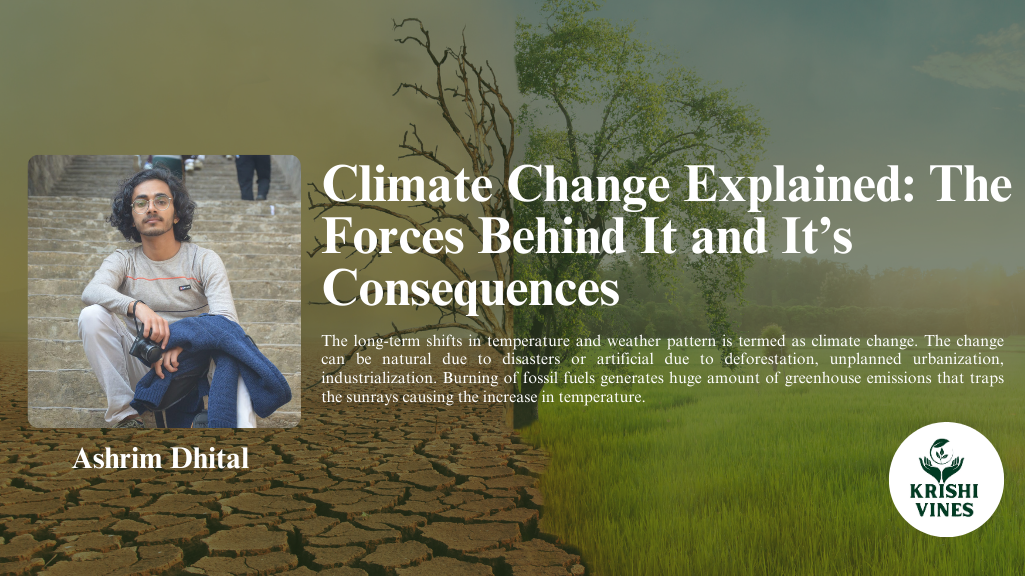
The long-term shifts in temperature and weather pattern is termed as climate change. The change can be natural due to disasters or artificial due to deforestation, unplanned urbanization, industrialization. Burning of fossil fuels generates a huge amount of greenhouse emissions that traps the sun rays causing the increase in temperature. Carbon dioxide and methane are the major greenhouse gases responsible for causing climate change. As per reports of the UN earth surface is 1.20C warmer than it was in the 1800s. Industrialization has played a major role in the sun’s increase in temperature.
The forces behind the climate change
Greenhouse gases are considered to be the major cause of climate change. Major Greenhouse gases causing climate change are carbon dioxide, methane, nitrous oxide etc. which are generated by the burning of coal, oil or gas which produces the carbon dioxide and nitrous oxide. Carbon dioxide accounts for the greatest portion of warming associated with global warming (ORD US EPA, 2017). The source of methane can be coal mining, waste decomposition in landfills and agriculture. Rice fields can generate certain amount of methane gas. Likewise, nitrous oxide is emitted during agricultural and industrial activities.
Burning of fossil fuels
The combustion of coal, oil and other natural gases leads to the emission of carbon dioxide.
Industrial activities and wastes
Industries like cement industries and other chemical industries are responsible for the emission of various greenhouse gases.
Agriculture
Overuse of nitrogenous fertilizer is contributing to the emission of methane. Various reports show the increase in methane emissions from the paddy fields where higher doses of nitrogenous fertilizers were used.
Deforestation
Forests are the natural purifier of air which absorb the carbon dioxide and release the oxygen. Deforestation leads to the release of much of the carbon stored by the trees to the atmosphere as carbon dioxide which contributes to climate change. (Charles Palmer, 2023).
The consequences of climate change
Due to its effects on water resources, forests, agriculture, snow melting and other effects climate change has become a threat to living beings on the earth. Nepal has been ranked 4th vulnerable country due to impacts of climate change and one of the least contributors to global greenhouse gas emission, emitting only about 0.027%. (Regan Sapkota, 2016)
- Natural disasters
Climate induced disasters had badly affected Nepal in recent years. Nepal is a mountainous country most of the large rivers originate from the mountains. Also, there are a large number of glaciers here in Nepal. Due to the increase in temperature, unusual flooding and glacial lakes outburst have become a major topic of concern. Recent floods of 2023,2024 had impacted the lives of many people residing in mid-hills to terai. Excess rainfall or flood events often causes the landslides. Uneven rain distribution within a country can lead to flooding in one part and drought in another. Drought can be a major cause leading to forest fire.
- Human health risks and migration
Rising air and water temperatures and more intense extreme events are expected to increase the risk of food and water borne diseases (USGCRP, 2018). Different respiratory and heart diseases, pest-related diseases like Lyme disease and West Nile Virus are being severe due to the change in climate.(OAR US EPA, 2022). Climate change can lead to the permanent migration of the people who are unable to adapt to its consequences. The climate induced hazards can force the people to permanent migration. Climate induced migration are more prevalent for long distant migration.(Kaczan & Orgill-Meyer, 2020)
- Increase in sea levels
The rise in sea level has begun to erode and inundate the coastal ecosystems. Since 1880s the global average rise in sea level is 8-9 inches. The rate of sea level rise has been doubled from most years of 20th century (0.06 inches) to last decade (0.14 inches).(“Climate Change,” 2023)
- Effects on agriculture
Nepal being an agricultural country about one third of the GDP is contributed by agriculture sector only. Effects of climate change had impacted Nepalese agriculture in different ways. It has many direct and indirect effects on agriculture. The effects such as destruction of standing crops or destruction of cultivable land by climate change induced disasters. The production and productivity of the crops have been affected by climate change. In the study carried out in Chitwan, the majority of farmers have perceived drought as the major impact of climate change and the nursery stage of rice to be highly prone to climate impact. Farmers had experienced the change in cropping duration, inferior performances of local land races leading to the adoption of new varieties, increased insect infestation and weed problems. (Sachin Gahatraj, 2018). Changes in the climatic factors such as temperature, solar radiation and precipitation have potential impact on crop production (Malla, 2009).
- Shifting of climatic zones
Climate change has been affecting ecosystem by shifting the climatic zones which results in species migration. Before the genotypes which were in cultivation in southern belt of Nepal; terai now they can be found to be adapted in hills too.
- Extinction of biodiversity
As per reports about one million species on land and in the ocean are at risk of becoming extinct with in few decades. (UN, n.d.)
- Increase disease pest infestation
Climate change has affected the disease pest population different ways. It has favored the insects in the expansion of their geographic distribution, increased survival during overwintering, increased number of generations, altered synchrony between plants and pests, altered interspecific interaction, increased risk of invasion by migratory pests, increased incidence of insect-transmitted plant diseases, and reduced effectiveness of biological control, especially natural enemies.(Skendžić, Zovko, Živković, Lešić, & Lemić, 2021)
Conclusion
Climate change is one of the greatest problems being faced by the human beings. The evidences of rising temperature, and other hazards are already clear. The effects of climate change are unavoidable as it directly affects the food security and other major aspects. For solving the climatic crisis global efforts should be made. Using the alternatives of fossil fuels, afforestation and waste management strategies should be implemented worldwide.
References
Charles Palmer, N. P. (2023, february 10). What is the role of deforestation in climate change and how can ‘Reducing Emissions from Deforestation and Degradation’ (REDD+) help? Retrieved from the london school of economics and political science: https://www.lse.ac.uk/granthaminstitute/explainers/whats-redd-and-will-it-help-tackle-climate-change/#:~:text=When%20deforestation%20occurs%2C%20much%20of,Africa%2C%20followed%20by%20South%20America.
Regan Sapkota, D. K. (2016). CLIMATE CHANGE AND ITS IMPACTS IN NEPAL. Researchgate.
Sachin Gahatraj, R. K. (2018). Impacts of climate change on rice production and strategies for. Journal of Agriculture and Natural Resources, 114-121.
UN. (n.d.). Causes and Effects of Climate Change. Retrieved from United Nations: https://www.un.org/en/climatechange/science/causes-effects-climate-change#:~:text=Climate%20change%20is%20the%20single,grow%20or%20find%20sufficient%20food.
Climate Change: Global Sea Level | NOAA Climate.gov. (2023, August 22). Retrieved October 19, 2024, from http://www.climate.gov/news-features/understanding-climate/climate-change-global-sea-level
Kaczan, D. J., & Orgill-Meyer, J. (2020). The impact of climate change on migration: A synthesis of recent empirical insights. Climatic Change, 158(3–4), 281–300. https://doi.org/10.1007/s10584-019-02560-0
Malla, G. (2009). Climate Change and Its Impact on Nepalese Agriculture. Journal of Agriculture and Environment, 9, 62–71. https://doi.org/10.3126/aej.v9i0.2119
Skendžić, S., Zovko, M., Živković, I. P., Lešić, V., & Lemić, D. (2021). The Impact of Climate Change on Agricultural Insect Pests. Insects, 12(5), 440. https://doi.org/10.3390/insects12050440
US EPA, OAR. (2022, March 20). Climate Change and Human Health [Overviews and Factsheets]. Retrieved October 19, 2024, from https://www.epa.gov/climateimpacts/climate-change-and-human-health
US EPA, ORD. (2017, November 2). Greenhouse Gases [Reports and Assessments]. Retrieved October 19, 2024, from https://www.epa.gov/report-environment/greenhouse-gases
USGCRP. (2018). Fourth National Climate Assessment (pp. 1–470). U.S. Global Change Research Program, Washington, DC. Retrieved from U.S. Global Change Research Program, Washington, DC website: https://nca2018.globalchange.gov