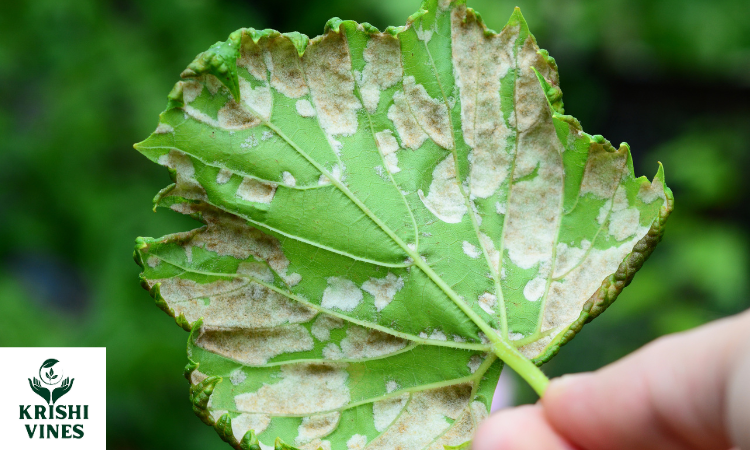
Downy Mildew of Crucifers: This disease is found all over the world where crucifers are grown. It affects a wide range of hosts i.e. turnip, cauliflower, Sarson, radish, cabbage etc.
Etiology: It is caused by the Peronospora parasitica, P. brassicae. The main difference with Downy Mildew of cucurbits is that it doesn’t form zoospores which is formed by the Pseudoperonospora cubensis in Cucurbits.

Picture Credit: ipmimages.org
Personospora has coenocytic mycelium which is intercellular with haustoria (Large Finger Shaped).. From the lower surface of the leaves through stomata, Conidiophore emerges. Finally, at the later stages Oospores is formed.
Symptoms: At first, symptoms appeared on the cotyledons’ leaves and several infections were also seen in seedling stages leading to mortality. Later on the undersheath of the leaves, Purplish brown spots appear. These spots on severed case may be crowded and causes leaves to DST case i.e. Dry, Shrivel and Tears early. Likewise, In stem swelling takes place which is limited by bending stalks abruptly. Finally, Flower buds and fruits may reduce their size.

Image Source: Semantic Scholar
Disease Cycle: First of all, Pathogen perennates the soil and seed from the oospores. Here wild hosts act as the primary source of inoculum and cause infection from the oospore through germ tube when the plant remains outside of the soil. Then, it will enter the host through stoma and develop new mycelium. Later on, leaves and inflorescence also get attacked and secondary infection causes from Conidia.
Disease Management: Management of downy mildew of crucifers requires various techniques. Early sowing is most necessary for avoiding infection. Spray DM – 45 @2 gm/lit, Ridomil MZ – 72 @ 2.5 gm/lit on repeated 10-15 days interval is necessary. Some common activities like crop debris destruction, Deep Summer Ploughing, Crop rotation avoiding crucifers for 3 years need to be done. Beside this, Clean cultivation with proper spacing is necessary that causes less infection.