INTRODUCTION
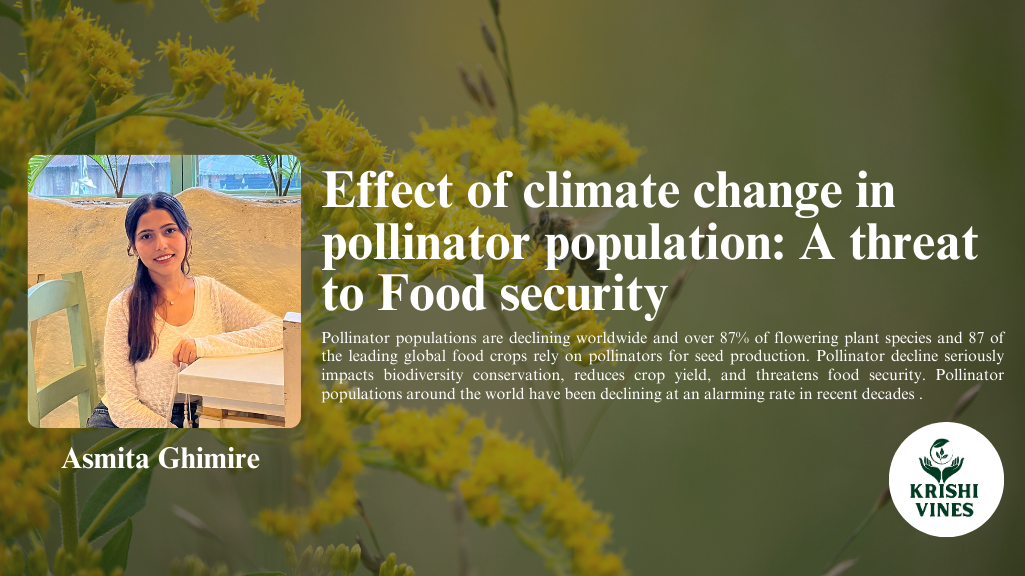
Pollinator populations are declining worldwide and over 87% of flowering plant species and 87 of the leading global food crops rely on pollinators for seed production. Pollinator decline seriously impacts biodiversity conservation, reduces crop yield, and threatens food security. Pollinator populations around the world have been declining at an alarming rate in recent decades . Approximately 16% of vertebrate pollinators, such as birds and bats, and 40% of invertebrate pollinators, such as bees and butterflies, are at risk of extinction. Species loss and steep population declines of insects, the most important group of pollinators in most biomes, have been recorded in all regions of the world. In order to create strategies and action plans to protect and conserve pollinator populations and the essential ecosystem services they provide we need to understand the main reasons for their worldwide decline. A range of factors, including habitat loss, pesticide use, pests and pathogens, pollution, and climate change can adversely affect pollinators. Climate change is altering the world’s ecosystems through direct effects of climate warming and precipitation changes but also indirectly through changes in biotic interactions. For instance, climate‐driven changes in plant and/or insect communities may alter plant–pollinator interactions, thereby influencing plant reproductive success and ultimately population dynamics of insect‐pollinated plants.
Contribution of Pollination to Food Security
In agro-ecosystems, pollinators are essential for orchard, horticultural and forage production, as well as the production of seed for many root and fibre crops. Pollinators such as bees, birds and bats affect 35% of the world’s crop production, increasing outputs of 87 of the leading food crops worldwide, plus many plant derived medicines in our pharmacies. Food security, food diversity, human nutrition and food prices all rely strongly on animal pollinators. This is particularly the case of horticultural crops. Diversification into horticultural crops is becoming an avenue to poverty alleviation amongst many farmers around the world. The trade in horticultural crops accounts for over 20% of developing countries’ agricultural exports, more than double that of cereal crops. Unlike the historical increase in cereal production, the expansion of production in fruits and vegetables has come primarily from increases in the area cropped, not from yield increases. The consequences of pollinator declines are likely to impact the production and costs of vitamin-rich crops like fruits and vegetables, leading to increasingly unbalanced diets and health problems. Thus, maintaining and increasing yields in horticultural crop under agricultural development is critically important to health, nutrition, food security and better farm incomes for poor farmers. The efforts of insects are largely forgotten in today’s agri-business world, but the bottom line shows just how important their contribution is. The world honey production is worth around £380,000,000, but the value of insect pollinated agriculture is worth somewhere in the region of £800,000,000,000, one must remember that this includes the contribution of all insect pollinators, not just honeybees.
Climate change significantly impacts pollinator populations through several interconnected factors:
- Direct Effects:
- Effect on diversity of pollinators:
Climate change, macroclimate in general, and microclimate in particular may have significanct effect in relative abundance and diversity of pollinators as they are sensitive and unable to acclimatize. This leads to the extinction of some species that are unable to acclimatize those frequent changes. Because of climate change most of the bee species loss their occurance areas.
- Effect on distribution of pollinators:
Bees are most prominent and distributed over large geographical area. The distribution is mainly depends on their thermal tolerance and plasticity to temperature changes. For example, European dark bee is restricted to an area where the average temperature during the month of July ranges from 15-20▫c. Similarly, the Eastern honeybee (Apis millifera),popularly known as Indian bee is distributed in some part of Asia, whereas the giant honeybee( Apis dorsata) is restricted to the tropical climate and higher altitudes.
- Effect on morphology of pollinators:
Morphological traits such as body size and proboscis length are directly connected with the foraging efficiency of pollinators. Pollen load carried out by pollinators is directly related to the body whereas proboscis length is important aspect for sucking the nectar from the nectar gland of a flower. Length of proboscis also directly related to the resource acquisition and pollination effectiveness.
In general rise in temperature is known to decrease the size and body weight of an insect probably because of increase metabolic rate and accelerated development.
- Effect on physiology of pollinators:
Climate change is also known to adversely effect the physiology of insect pollinators. Various physiological activities of insects such as food consumption, digestion, utilization, diapauses, hibernation etc are affected by temperature as well as concentration of CO2.
- Effect on flight and foraging activity of pollinators:
Climate change is known to affect the behavior of insect pollinators by variety of ways such as by affecting foraging and flight activity or by effecting communication. During the extreme of climate event, whether during excess hot or cold, or rain, bees donot go for collecting food and water. If such condition prolonged for long period of time ,then bees automatically die. For each and every pollinator, there is an optimum time for carrying out foraging activity.
- Indirect effects:
- Habitat Loss: Changing climates can alter ecosystems, leading to habitat loss and fragmentation, which affects the availability of food and nesting sites for pollinators. For example, flies appear to become more abundant in colder and wetter areas whereas bees are often more abundant in warmer and drier habitats , suggesting that the composition and dominance of pollinator assemblages may change with climate warming. Due to urban sprawl (the development of which is accelerating climate change) and increasingly extreme weather, bee habitats are under threat. Wildflower meadows, marshes, forests, woodland are all declining and this means bees have fewer habitats to reside. 17% of bees are already extinct in regions of the UK such as the East of England which is notorious for its diverse range of habitats.
2. Phenological Mismatches: As temperatures rise, the timing of flowering plants may shift. If plants bloom earlier than usual, pollinators that rely on them for food might not be active at that time, leading to reduced foraging opportunities. Climate change is making flowers bloom half a day earlier each year, which means that plants are now blooming a month earlier than 45 years ago. Plants blooming earlier ultimately means that they do not get pollinated and bees are left without food.
3. Increased Competition: Warmer climates can allow non-native species to thrive, increasing competition for resources among pollinators. This can stress native pollinator populations.
4. Disease and Pests: Warmer temperatures can facilitate the spread of diseases and parasites that affect pollinators, such as bees. This can weaken populations and reduce their resilience. Bees are already vulnerable to diseases, fungi, and mites that impact their lifespan and ability to pollinate. These harmful diseases increase alongside temperatures meaning bees are at increased risk as climate change worsens.
Overall, the decline of pollinator populations due to climate change poses significant risks to biodiversity and food security, as many crops rely on these essential species for successful pollination. Conservation efforts are increasingly crucial to mitigate these effects.
Some examples of effect of climate change on pollinators:
The story of Monarch butterfly:
The Monarch butterfly is a pollinator species with an enormous impact on maintaining the health of the ecosystem. It is a yearly visitor to the Kenilworth Park and Aquatic Gardens. In addition to pollinating many plant species, Monarchs are a food source to other wildlife like birds and insects. However, the Eastern Monarch butterfly population has declined by 80% from 2000–2020 causing concern. This decline has led to considerations of putting the Monarch on the Endangered Species.
Decline of Milkweed
Milkweed is the only plant genus on which Monarch caterpillars feed. The milkweed plants support Monarch larvae, caterpillars, and adults as an essential part of their diet. Declines in Milkweed plants have led to declines in Monarch butterfly populations.
Milkweed is negatively affected by deforestation, the use of pesticides and herbicides, and the changing climate. Climate change can accelerate the spread of invasive species like the Purple Loosestrife, an invasive plant that looks very similar to the milkweed. The spread of Purple Loosestrife has injured the Monarch butterfly population, as butterflies mistake the Purple Loosestrife as milkweed and lay their eggs on it.
Muddled Monarch Migration
Monarch biology is sensitive to temperature as they rely on temperature changes to signal the beginning of their lengthy migration. If Monarchs migrate too early in the spring, the milkweed will not have had enough time to mature and the Monarchs will be left with nowhere to lay their eggs. In the fall, when there is an abundance of milkweed and warm temperatures, Monarchs are prevented from departing for their overwintering grounds.
Further impacts of climate change, such as extreme weather events like tropical storms and hurricanes, damage milkweed and Monarch populations-placing the iconic butterflies at even greater risk.
Different ways to conserve pollinators against climate change:
1.Avoid use of pesticides:
Many common pesticides interfere with pollinators’ neurology, and pollinators can carry these chemicals back to their hives with them, affecting the whole population. Ironically, if treated with pesticides, the most perfect-looking gardens can have very negative impacts on the ecosystem.
2.Promotion of organic farming:
Organic farming nourishes healthy pollinator communities. Buying food grown with organic farming techniques cuts down on demand for pesticide-laden crops. Natural-food grocery stores like Whole Foods, Lassens, and Erewhon offer primarily organic foods. In recent years, major supermarkets like Ralphs and Safeway have begun stocking organic sections as well.
3.Promoting pollinator friendly farming practices
Encourage the growth of native plants that provide food and habitat for local pollinators. Native species are often better adapted to the local environment and more resilient to climate change. Follow farming practices such as agroforestry, hedgerows and organic farmimg.
4. Enhance Urban Green Spaces: Incorporate pollinator-friendly plants in urban landscaping, parks, and community gardens to create corridors of habitat.
5. Provide Water Sources: Ensure that there are clean water sources available for pollinators, such as small water features or bird baths.
6. Support Local Beekeepers: Buy honey and other bee products from local beekeepers who practice sustainable beekeeping methods.
7. Monitor Pollinator Populations: Participate in or support citizen science projects that track pollinator health and populations to identify trends and inform conservation efforts.
8. Combat Climate Change: Engage in broader climate action efforts, such as reducing carbon footprints and supporting renewable energy initiatives, as these have direct benefits for pollinator health.
CONCLUSION:
Widespread use of sustainable practices in agriculture, and further development of integrated pollinator management strategies, eco-friendly strategies including reduction of pesticide use, will help preserve pollinators. Potential adverse effects of managed bees on the local wild bee populations must be mitigated. Non-lethal collection methods should be developed and adopted globally in response to the increasing need for baseline pollinator data collection. Adopting a more holistic approach to pollinator conservation, with management strategies that integrate natural habitats and agricultural systems, together with managed and wild bees, should become a high priority worldwide. Measures must keep being implemented to reduce climate change and prevent its serious negative impacts on pollinators. Climate change has the most diverse negative impacts on pollinators and is the threat most difficult to control. However, its consequences threaten food security and world stability thus efforts to control it must be prioritized on a global scale.