Introduction
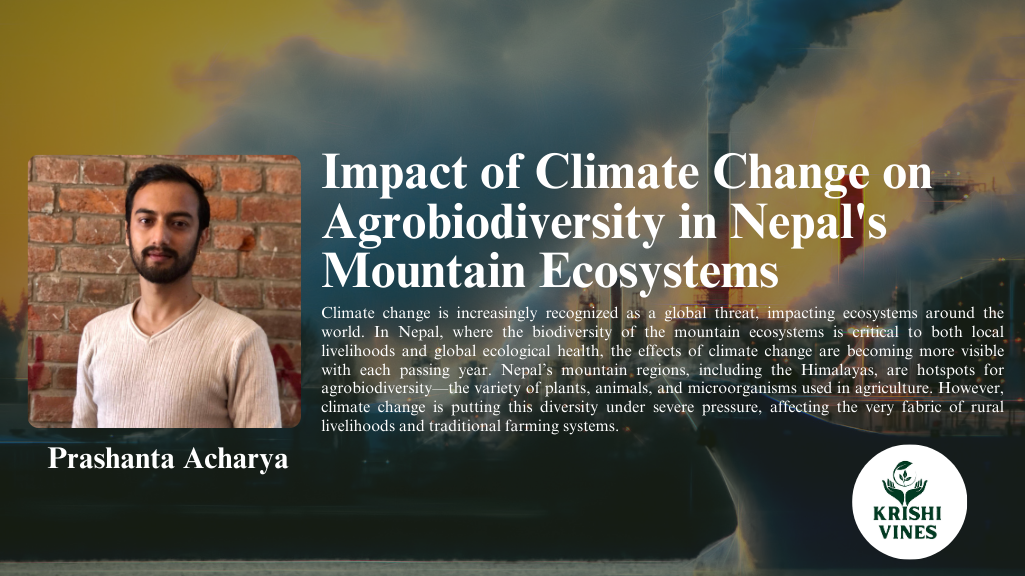
Climate change is increasingly recognized as a global threat, impacting ecosystems around the world. In Nepal, where the biodiversity of the mountain ecosystems is critical to both local livelihoods and global ecological health, the effects of climate change are becoming more visible with each passing year. Nepal’s mountain regions, including the Himalayas, are hotspots for agrobiodiversity—the variety of plants, animals, and microorganisms used in agriculture. However, climate change is putting this diversity under severe pressure, affecting the very fabric of rural livelihoods and traditional farming systems.
In this article, we’ll delve into how climate change is impacting agrobiodiversity in Nepal’s mountain ecosystems, exploring recent examples of these changes and the adaptive responses emerging from local communities.
Understanding Agrobiodiversity
Agrobiodiversity refers to the variety of plant species, animal breeds, and microorganisms used in farming systems. It is crucial for food security, ecosystem sustainability, and resilience to environmental changes. In Nepal, agrobiodiversity includes the rich variety of crops, such as rice, millet, barley, and traditional vegetables, as well as indigenous livestock breeds. This diversity has allowed mountain communities to thrive in some of the harshest environments on Earth.
Recent studies have underscored the importance of preserving agrobiodiversity in the face of climate change. For instance, a 2022 report by the International Centre for Integrated Mountain Development (ICIMOD) highlighted how the genetic diversity of traditional crops in the high-altitude regions of Nepal is essential for adapting to new climate conditions. The adaptability of these crops to cold, drought, and poor soil conditions offers solutions for future agricultural resilience.
Nepal’s Mountain Ecosystems: A Brief Overview
Nepal’s mountain regions, home to eight of the world’s ten highest peaks, are incredibly diverse. These ecosystems range from tropical forests at lower elevations to alpine meadows and glaciers at higher altitudes. This diversity has made Nepal one of the global hotspots for agrobiodiversity, with thousands of plant species and numerous traditional crops and livestock breeds.
One of the recent examples illustrating this importance is the conservation of rare varieties of barley and buckwheat in the Mustang region. These crops, cultivated for centuries in harsh climates, are not only culturally significant but also hold potential for global climate-resilient farming systems. Mustang farmers, supported by organizations such as Bioversity International, are increasingly focusing on conserving these varieties, recognizing their potential in adapting to warmer and drier conditions.
Climate Change in Nepal
Nepal has been witnessing significant climatic shifts over the last few decades, which are increasingly impacting the country’s fragile mountain ecosystems. According to the National Adaptation Plan (NAP) 2022, temperatures in Nepal are rising at an average rate of 0.06°C per year, with the rate even higher in the mountainous regions. Changes in rainfall patterns, more intense monsoons, and longer dry spells have already started disrupting traditional farming systems.
The rapid melting of glaciers, such as the Imja Glacier near Mount Everest, is one of the most visible impacts of climate change. A recent report from the Nepal Academy of Science and Technology (NAST) in 2023 noted that Himalayan glaciers are receding faster than previously predicted, directly affecting water availability in these regions. This, in turn, has significant implications for irrigation-dependent agriculture.
Impact of Climate Change on Agrobiodiversity
Disruption of Traditional Farming Cycles
In Nepal’s mountain regions, traditional farming is intricately tied to seasonal cycles. Crops like maize, millet, and barley are planted and harvested based on predictable weather patterns. However, climate change is disrupting these cycles. Recent examples from the Dolakha district reveal that erratic rainfall and increasing temperatures have forced farmers to delay planting, resulting in lower crop yields.
According to a 2023 study by the Food and Agriculture Organization (FAO), farmers in high-altitude areas have reported a shortening of the growing season by up to three weeks. This has led to significant disruptions in the cultivation of staple crops, such as barley and millet, which are essential for food security in these remote areas.
Changes in Crop Varieties and Farming Practices
With rising temperatures and unpredictable rainfall, many farmers in Nepal’s mountain regions are shifting away from traditional crops. For example, farmers in the Rasuwa district have started cultivating more heat-tolerant crops like potatoes and apples, replacing traditional cereals such as barley. This shift not only affects local food systems but also erodes the region’s rich agrobiodiversity.
A recent initiative by the Annapurna Conservation Area Project (ACAP) is working to reverse this trend. In 2022, ACAP introduced a seed bank program to conserve indigenous seed varieties, providing farmers with access to traditional crops that are better adapted to local conditions.
Loss of Indigenous Knowledge and Cultural Practices
As climate change forces farmers to abandon traditional crops, indigenous knowledge, and cultural practices tied to these crops are also at risk of disappearing. For example, in the Humla region, farmers traditionally practiced rotational cropping with native varieties of buckwheat and millet, using knowledge passed down for generations. However, as newer, more commercially viable crops are introduced, these practices are being lost.
The loss of such knowledge has wider implications beyond agriculture. It disrupts cultural heritage and community identity. A 2023 project funded by the UN Development Programme (UNDP) in the Karnali region seeks to document and preserve this traditional knowledge before it disappears, working with local elders to teach younger generations about indigenous farming practices.
Shift in Growing Zones
One of the most striking impacts of climate change in Nepal is the shift in growing zones. Crops that were once grown at lower altitudes, such as rice, are now being cultivated at higher elevations due to rising temperatures. Recent fieldwork in the Khumbu region has shown that farmers are now able to grow crops like maize and potatoes at altitudes of over 3,000 meters—something that was not possible just two decades ago.
However, this shift comes with challenges. A 2023 report by the Ministry of Agriculture and Livestock Development (MoALD) highlighted that soil quality and water availability at higher altitudes may not be sufficient to sustain these crops in the long term, risking both the viability of these new growing zones and the traditional crops displaced by this shift.
Threats to Indigenous Crops
Climate change poses a significant threat to Nepal’s indigenous crops, many of which are highly sensitive to temperature and rainfall changes. Crops like the Jumla red rice, a unique variety grown in the high-altitude region of Jumla, are now at risk. A 2023 study conducted by the Nepal Agricultural Research Council (NARC) found that changing rainfall patterns are making it difficult to grow this rice, which relies on a specific amount of water at key stages of growth.
In response, local farmers, with the help of NGOs like Practical Action, have been experimenting with water-conserving techniques such as drip irrigation to save the crop. However, the long-term survival of this and other indigenous crops remains uncertain.
Impact on Livestock Diversity
Livestock diversity is another crucial aspect of agrobiodiversity in Nepal’s mountain ecosystems. Indigenous breeds of cattle, yaks, and sheep, which are well-adapted to the cold, high-altitude environment, are now under threat as warmer temperatures and changing vegetation patterns reduce the availability of their natural fodder.
For example, in the Dolpa region, yak herders have reported difficulties in finding suitable grazing grounds due to shrinking pastures. The traditional transhumance system, where livestock are moved between high and low pastures based on the season, is becoming increasingly untenable as climate patterns become unpredictable. A 2022 initiative by ICIMOD is working to preserve the genetic diversity of indigenous yak breeds by creating community-based breeding programs.
Water Scarcity and Its Effects on Agriculture
Water scarcity is a growing concern in Nepal’s mountains, driven by both glacial retreat and erratic rainfall. The shrinking of glaciers, such as those in the Langtang Valley, has led to reduced river flows that are vital for irrigation. A 2023 report from WWF Nepal highlighted that many farmers in the Mustang and Manang regions are now facing severe water shortages, impacting their ability to cultivate traditional crops.
In response, local communities, with support from the Global Environment Facility (GEF), have implemented rainwater harvesting systems and constructed water-efficient irrigation canals to cope with the reduced water supply.
Pest and Disease Proliferation
As temperatures rise, pests and diseases that were once rare in Nepal’s mountainous regions are becoming more common. Farmers in the Dolakha and Ramechhap districts, for example, have reported increased infestations of fall armyworm, which devastates maize crops. A 2022 study by the National Plant Protection Organization (NPPO) found that warmer temperatures are allowing these pests to survive and reproduce at higher altitudes, posing a significant threat to local agriculture.
In response, government agencies and NGOs are working with local farmers to implement integrated pest management (IPM) strategies, which combine traditional pest control methods with modern techniques to minimize crop damage.
Resilience of Agrobiodiversity
Despite the challenges posed by climate change, agrobiodiversity in Nepal’s mountain regions has shown remarkable resilience. Indigenous crops such as finger millet and buckwheat, which have adapted over centuries to harsh conditions, are more resistant to drought and poor soil than many introduced varieties. A 2023 initiative by Bioversity International has been working with farmers in the Annapurna region to promote the cultivation of these resilient crops as a way to adapt to changing climate conditions.
Local Community Responses and Adaptation Strategies
Mountain communities in Nepal are not passively enduring the impacts of climate change; they are actively seeking ways to adapt. In the Solukhumbu district, for instance, farmers are practicing agroforestry, integrating fruit trees with traditional crops to enhance soil fertility and reduce erosion. A 2022 project funded by the World Bank in this region demonstrated that agroforestry can increase yields and improve food security while also conserving agrobiodiversity.
Role of Policy and Government Initiatives
Nepal’s government has taken steps to address the dual challenges of climate change and agrobiodiversity loss. In 2023, the Ministry of Agriculture launched the Climate-Resilient Agriculture Strategy, which aims to support farmers in adopting sustainable practices that conserve biodiversity. The strategy includes provisions for promoting indigenous crops and livestock breeds, recognizing their importance in building climate resilience.
International Efforts to Support Agrobiodiversity in Nepal
International organizations are playing a vital role in supporting agrobiodiversity conservation in Nepal. For example, a 2023 project by the Global Crop Diversity Trust (Crop Trust) in partnership with the Nepal Agricultural Research Council (NARC) has been working to create seed banks for endangered crop varieties. These efforts are crucial for preserving genetic diversity, which will be key to adapting agriculture to future climate conditions.
Conclusion
The impacts of climate change on agrobiodiversity in Nepal’s mountain ecosystems are profound and far-reaching. From shifting growing zones and water scarcity to the loss of indigenous crops and livestock breeds, the challenges are immense. However, Nepal’s rich agrobiodiversity, combined with the resilience and ingenuity of its farming communities, offers hope for adaptation. With continued support from national policies and international organizations, Nepal can protect its agrobiodiversity and build a more resilient future in the face of climate change.
FAQs
What is agrobiodiversity, and why is it important for mountain ecosystems?
Agrobiodiversity includes the variety of plants, animals, and microorganisms used in agriculture. It is crucial for food security, ecosystem sustainability, and resilience, particularly in fragile mountain ecosystems like those in Nepal.
How is climate change affecting traditional farming practices in Nepal?
Climate change is disrupting traditional farming cycles, shifting growing zones, and forcing farmers to abandon indigenous crops. This has led to the loss of both biodiversity and cultural practices tied to these farming systems.
What are the key threats to agrobiodiversity in Nepal’s mountain ecosystems?
Key threats include rising temperatures, erratic rainfall, water scarcity, and the proliferation of pests and diseases, all of which are exacerbated by climate change.
How are local communities adapting to climate change impacts?
Communities are adopting agroecological practices such as agroforestry, crop diversification, and traditional water management techniques to adapt to changing conditions while conserving agrobiodiversity.
What can be done to preserve Nepal’s agrobiodiversity in the face of climate change?
Efforts should focus on conserving indigenous crops and livestock breeds, promoting sustainable farming practices, and integrating agrobiodiversity conservation into national and international climate adaptation strategies.