Articles

Effect of Urbanization on Water Quality – By Namrata Kandel || Krishi Vines

Urbanization can be defined as a multidimensional process characterized by the increasing concentration of populations in urban centers, leading to significant shifts in socio-economic structures, land use patterns, and cultural dynamics. This process often involves the transformation of rural landscapes into urbanized environments, driven by factors such as industrialization, economic opportunities, and migration patterns.  In…
Read More

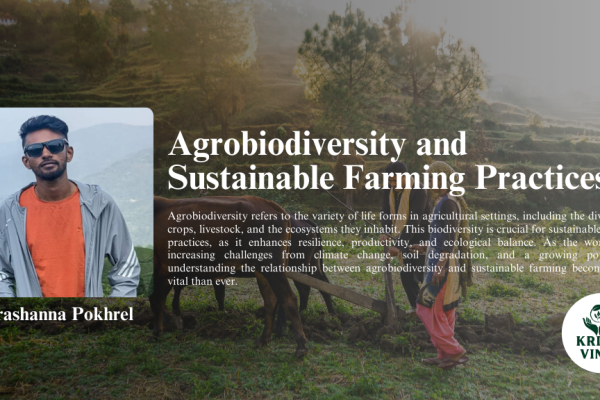
Agrobiodiversity and Sustainable Farming Practices – By Prashanna Pokhrel || Krishi Vines

Introduction Agrobiodiversity refers to the variety of life forms in agricultural settings, including the diversity of crops, livestock, and the ecosystems they inhabit. This biodiversity is crucial for sustainable farming practices, as it enhances resilience, productivity, and ecological balance. As the world faces increasing challenges from climate change, soil degradation, and a growing population, understanding…

Read More

Lamjung’s Fragnant Future In Peril: Climate Change Threatens Large Cardamom – By Sabunam Subba || Krishi Vines

Climate Change and Its Impact The demand for large cardamom has been increasing in the global market but cardamom farming difficulty has also increased due to the climate change and its impact (Mishra & Gurung, 2023). Climate change is the long-term shift in global temperatures and weather patterns, primarily caused by human activities, resulting in…

Read More

Phytoremediation: A Natural Approach to Environmental Cleanup – Sagar Poudel || Krishi Vines

Phytoremediation is a cutting-edge, environmentally friendly technique that utilizes plants and their associated microorganisms to eliminate, reduce, or neutralize environmental contaminants from soil, water, sediments, and even air. This sustainable method presents a natural alternative for dealing with pollution caused by persistent organic pollutants (POPs), such as pesticides, pharmaceuticals, petroleum hydrocarbons, and polychlorinated biphenyls (PCBs)….

Read More

The Role of Pollinators in Agroecosystem Resilience – By Kristina Ghele || Krishi Vines

Pollinators are vital components of agroecosystems, significantly contributing to crop production and biodiversity. This article examines the role of pollinators in enhancing agroecosystem resilience, particularly in the context of environmental changes and climate variability. We explore the mechanisms through which pollinators influence ecosystem stability, food security, and agricultural sustainability. Additionally, we discuss the threats faced…

Read More

Climate Change and Agrobiodiversity in Nepal – By Ashok Sapkota || Krishi Vines

Introduction Nepal, a country rich in cultural and biological diversity, faces significant challenges due to climate change. With its varied topography, ranging from the lowland Terai plains to the towering Himalayas, Nepal’s agricultural systems are diverse but highly vulnerable to climatic shifts. Agrobiodiversity—the variety of plants, animals, and microorganisms that contribute to agricultural production—is crucial…

Read More

Conservation Strategies for Agrobiodiversity: Traditional Knowledge vs. Modern Practices – By Krishna Budha || Krishi Vines

Introduction Agrobiodiversity, or agricultural biodiversity, refers to the variety and variability of plants, animals, and microorganisms that are directly or indirectly involved in food and agriculture. It includes the diversity of species used in agriculture, such as crops, livestock, and their wild relatives, as well as the ecosystems in which they are cultivated. Agrobiodiversity is…

Read More

Impact of Climate Change on Agrobiodiversity in Bhaktapur, Nepal: Challenges and Adaptive Strategies – By Nisha Lamichhane || Krishi Vines

Introduction Bhaktapur, an ancient city in Nepal renowned for its cultural heritage, is also home to diverse agricultural practices deeply embedded in the region’s history. For centuries, farmers in Bhaktapur have cultivated a wide range of crops, including rice, maize, and vegetables, contributing to the agrobiodiversity that sustains the local community. However, climate change poses…

Read More

Biodiversity and Human Health: The Connection We Can’t Ignore – By Bandana Shah || Krishi Vines

Biodiversity the variety of life on Earth, including plants, animals, and microorganisms—is essential for the health of our ecosystems. But what is often overlooked is the profound impact biodiversity has on human health. The intricate relationships between the natural world and our well-being are undeniable, shaping everything from the air we breathe to the food…

Read More
Back To Top