Impact of Climate Change in Organic Agriculture – By Surya Upadhyaya || Krishi Vines

Introduction Climate change is a natural process but recent trends related to climate change are alarming mainly due to anthropogenic reasons. Climate change is making a big impact on agriculture everywhere. The level of greenhouse gases (GHGs) mainly carbon dioxide (CO2), nitrous oxide (N20) and methane (CH4) have been rapidly increasing after the industrial revolution….

Read More

Digital Seeds: Leveraging Technology for Agrobiodiversity Conservation – Bitisha Subedi || Krishi Vines

In recent years, the intersection of technology and agriculture has become increasingly significant, particularly in the realm of agrobiodiversity conservation. With the world confronting issues like climate change, habitat destruction, and unsustainable farming, technology is emerging as a key tool in preserving the genetic diversity of crops and livestock. Digital seeds, a collective term referring…

Read More

Agrobiodiversity Enhancement  Through  Agroecological Approaches – By Smreeti Paudel || Krishi Vines

Enhancing biodiversity through agroecological methods entails incorporating ecological concepts into farming methods to build more resilient and sustainable ecosystems. Agroecology encourages organic agricultural practices, crop rotation, and a variety of crops to promote soil health and natural pest management. In addition to increasing biodiversity on farms, this improves ecosystem services including nutrient cycling and pollination,…

Read More

Climate Smart Agriculture: A sustainable Future – By Stuti Acharya || Krishi Vines

Climate Smart Agriculture (CSA) is a landscape management approach that adapts farming methods, livestock, and crops to the current anthropogenic climate change. It aims to reduce greenhouse gas emissions while ensuring food security for the growing global population. So, the emphasis is not just on sustainable agriculture, but also on boosting agricultural output. Climate smart agriculture…

Read More

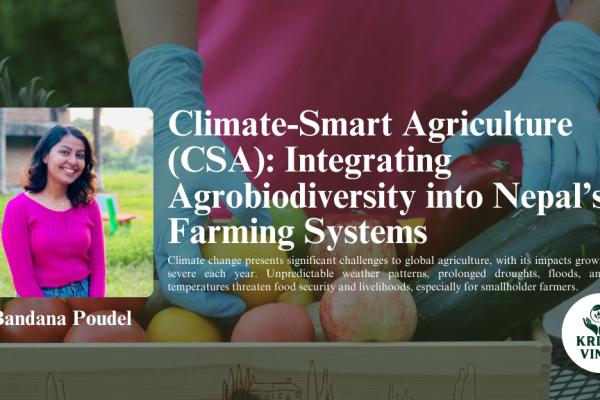
Climate-Smart Agriculture (CSA): Integrating Agrobiodiversity into Nepal’s Farming Systems – By Bandana Paudel || Krishi Vines

Abstract As global agricultural systems face escalating threats from climate change, Nepal’s unique geography and rich cultural heritage highlight the urgency for adaptive practices. This article explores the principles of Climate-Smart Agriculture (CSA) and emphasizes the critical role of agrobiodiversity in enhancing the resilience and sustainability of farming systems in Nepal. By implementing integrated agricultural…

Read More

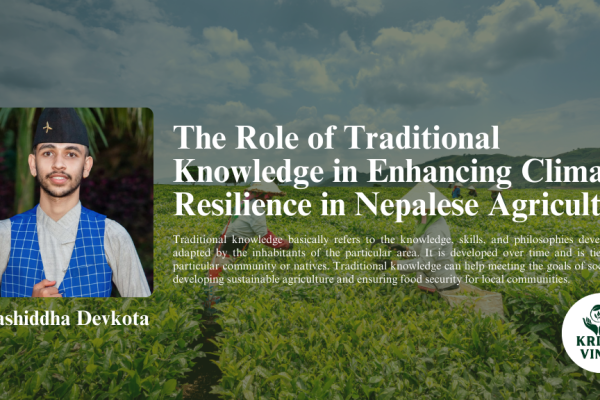
The Role of Traditional Knowledge in Enhancing Climate Resilience in Nepalese Agriculture – By Prashiddha Devkota || Krishi Vines

Traditional knowledge basically refers to the knowledge, skills, and philosophies developed or adapted by the inhabitants of the particular area. It is developed over time and is tied to the particular community or natives. Traditional knowledge can help meeting the goals of societies by developing sustainable agriculture and ensuring food security for local communities. Traditional…

Read More

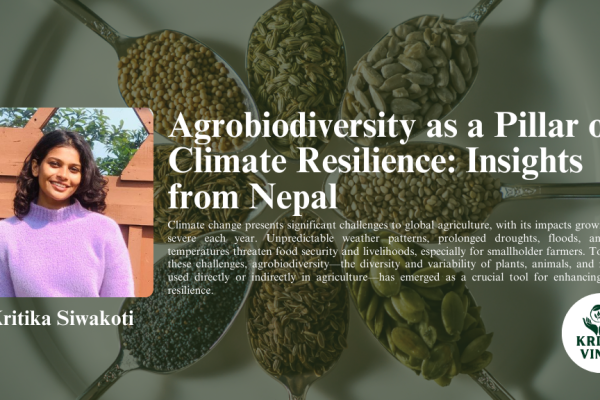
Agrobiodiversity as a Pillar of Climate Resilience: Insights from Nepal – By Kritika Shiwakoti

Climate change presents significant challenges to global agriculture, with its impacts growing more severe each year. Unpredictable weather patterns, prolonged droughts, floods, and rising temperatures threaten food security and livelihoods, especially for smallholder farmers. To address these challenges, agrobiodiversity—the diversity and variability of plants, animals, and microbes used directly or indirectly in agriculture—has emerged as…

Read More

Impact Of Microplastic In Local Water Bodies In Nepal: A Growing Environmental Concern – By Nikita Thapa || Krishi Vines

Nepal, known for its rich biodiversity and abundant water resources, faces increasing environmental challenges, including the contamination of local water bodies with microplastics. Microplastics are the plastic particles smaller than 5 mm in diameter. They enter the environment either as primary or secondary microplastics. Primary microplastics are released directly in their original form often from…

Read More

Innovative Tools and Techniques for Agrobiodiversity Conservation – By Sudarshan Panta || Krishi Vines

The varied topography and climatic conditions of Nepal host an astounding level of agrobiodiversity. Besides underpinning national agriculture, this biodiversity indirectly supports livelihoods and further improves food security. However, rapid urbanization, climate change, and unsustainable agricultural practices now pose significant threats to this valuable resource. Thus, against these, innovative tools and techniques are rising to…

Read More

Climate-Resilient Crops in Nepal: Harnessing Agrobiodiversity for Sustainable Agriculture – By Resham Basnet || Krishi Vines

Nepal, with its diverse agroecological zones, is highly vulnerable to climate change impacts, such as erratic rainfall patterns, droughts, and rising temperatures. These changes threaten food security, livelihoods, and ecosystems, especially for smallholder farmers who rely on traditional agricultural practices. In response, there is a growing emphasis on developing and promoting climate-resilient crops through the…

Read More
Back To Top