1. Introduction:
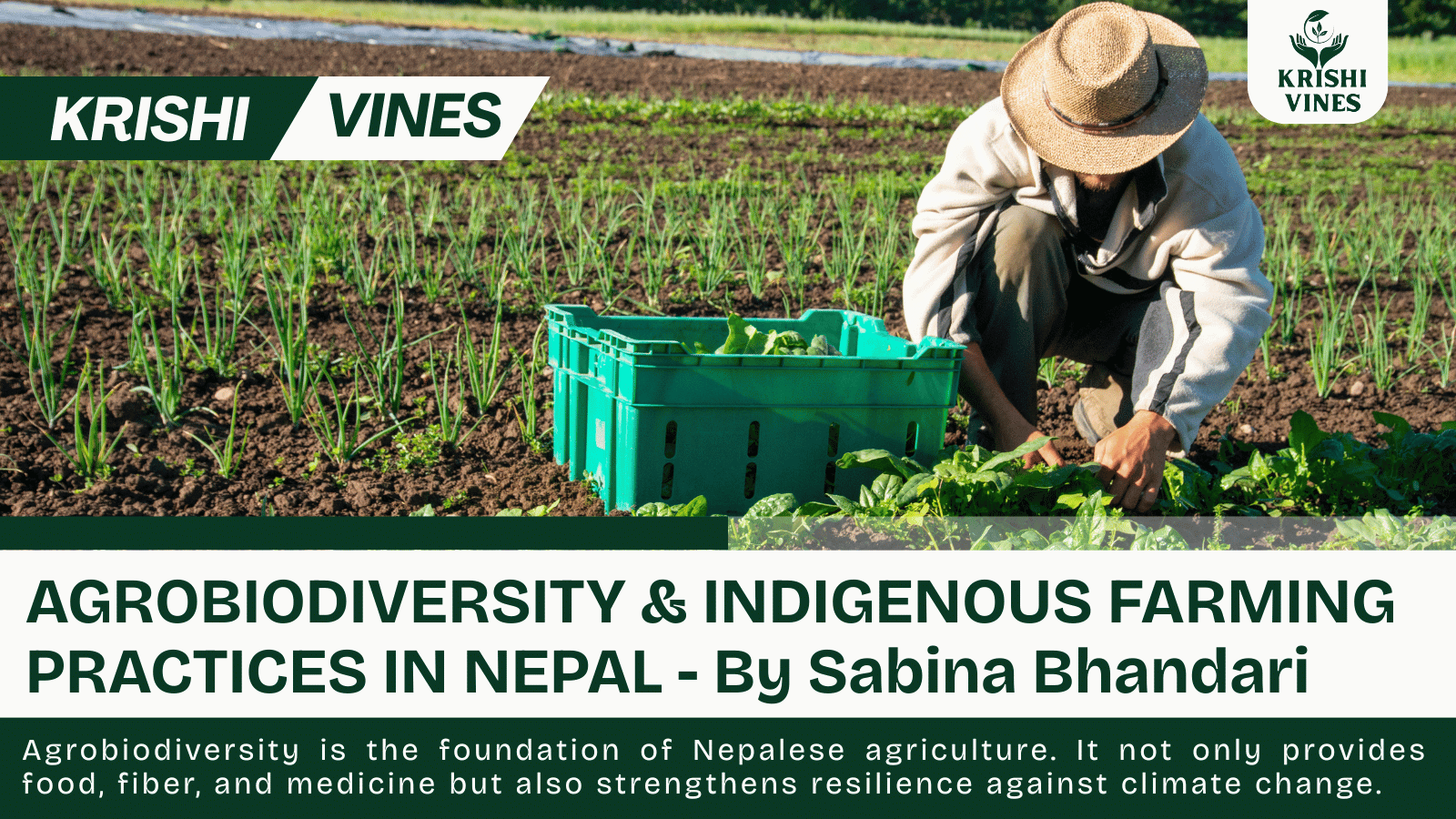
Nepal, a country renowned for its rich biodiversity and unique geographical features, faces significant challenges due to climate change. This article explores the impact of climate change on the vulnerability of agrobiodiversity in Nepal, examining the complex interplay between changing climatic conditions and the nation’s agricultural ecosystems.
2. Background:
Nepal’s agrobiodiversity is a crucial component of its cultural heritage and food security. The country’s varied topography, ranging from lowland Terai to high Himalayan regions, has fostered a diverse array of agricultural species and varieties adapted to specific microclimates(Gauchan et al., 2020).However, this diversity is increasingly threatened by the effects of global climate change. Nepal has experienced significant climatic changes in recent decades:
- The average annual temperature in Nepal has risen by 0.06°C per year between 1975 and 2005 (Pandey & Bardsley, 2015)
- Rainfall patterns have become more erratic, with some regions experiencing increased drought and others facing more frequent extreme precipitation events.(Xu et al., 2009)
- The Himalayan glaciers are retreating at an alarming rate, affecting water availability for agriculture (Bolch et al., 2019)
Unlike other environmental components, climate change has substantial impacts on agrobiodiversity. Climate change is altering the suitable habitats for many plant species. A study by Adhikari et al., (2009) projected that by 2050, the distribution of several important crop wild relatives in Nepal could shift significantly upward in elevation or northward in latitude. This shift threatens the genetic diversity of these species and their ability to adapt to changing conditions.
Similarly, warmer temperatures and changing precipitation patterns are conducive to the spread of pests and diseases. For instance, Manandhar et al., (2016) reported an increase in the incidence of rice blast disease in higher altitude regions of Nepal, areas previously unsuitable for the pathogen. Climate change is putting pressure on traditional crop varieties that are often more resilient to local conditions. Yadav et al., (2018) found that farmers in the mid-hills of Nepal are increasingly abandoning local landraces in favor of improved varieties that can better withstand changing climatic conditions, leading to genetic erosion. Changes in precipitation patterns and glacial melt are affecting water availability for agriculture. Dahal et al., (2016) observed that irregular monsoon patterns have led to increased water stress in rain-fed agricultural systems, particularly impacting drought-sensitive crops.
The vulnerability of Nepal’s agrobiodiversity to climate change can be assessed through three components:
- Exposure: The degree to which agricultural systems are exposed to climatic variations.
- Sensitivity: The extent to which crops and livestock are affected by climate change.
- Adaptive capacity: The ability of agricultural systems and communities to adjust to climate change.
A study by Gentle & Maraseni, (2012) found that communities in the western mountains of Nepal have high exposure and sensitivity to climate change, coupled with low adaptive capacity, making their agrobiodiversity particularly vulnerable.
Several strategies have been proposed and implemented to reduce the vulnerability of agrobiodiversity. Conservation of crop wild relatives are in practice through initiation and development of different In-situ and ex-situ conservation efforts, which are crucial for preserving genetic diversity Joshi et al., (2018). Promotion of climate-smart agriculture is being done time to time. Techniques such as agroforestry and conservation agriculture can enhance resilience (Bhatta et al., 2017). Development of numerous community seed banks throughout the country is another strategy adapted. They play a vital role in preserving local varieties and enhancing seed security(Vernooy et al., 2017).Enhancing farmers’ knowledge and skills in climate change adaptation is essential for long-term resilience
3. Conclusion
Climate change poses a significant threat to the agrobiodiversity of Nepal, with far-reaching implications for food security, livelihoods, and cultural heritage. While the challenges are substantial, targeted conservation efforts, adaptive agricultural practices, and supportive policies can help mitigate the vulnerability of Nepal’s agrobiodiversity to climate change. Continued research and collaborative action among stakeholders are essential to safeguard this invaluable resource for future generations.
References
Adhikari, S., Bajracharaya, R. M., & Sitaula, B. K. (2009). A Review of Carbon Dynamics and Sequestration in Wetlands. Journal of Wetlands Ecology, 42–46. https://doi.org/10.3126/jowe.v2i1.1855
Bhatta, G. D., Ojha, H. R., Aggarwal, P. K., Sulaiman, V. R., Sultana, P., Thapa, D., Mittal, N., Dahal, K., Thomson, P., & Ghimire, L. (2017). Agricultural innovation and adaptation to climate change: Empirical evidence from diverse agro-ecologies in South Asia. Environment, Development and Sustainability, 19(2), 497–525. https://doi.org/10.1007/s10668-015-9743-x
Bolch, T., Shea, J. M., Liu, S., Azam, F. M., Gao, Y., Gruber, S., Immerzeel, W. W., Kulkarni, A., Li, H., Tahir, A. A., Zhang, G., & Zhang, Y. (2019). Status and Change of the Cryosphere in the Extended Hindu Kush Himalaya Region. In P. Wester, A. Mishra, A. Mukherji, & A. B. Shrestha (Eds.), The Hindu Kush Himalaya Assessment: Mountains, Climate Change, Sustainability and People (pp. 209–255). Springer International Publishing. https://doi.org/10.1007/978-3-319-92288-1_7
Dahal, P., Shrestha, N. S., Shrestha, M. L., Krakauer, N. Y., Panthi, J., Pradhanang, S. M., Jha, A., & Lakhankar, T. (2016). Drought risk assessment in central Nepal: Temporal and spatial analysis. Natural Hazards, 80(3), 1913–1932. https://doi.org/10.1007/s11069-015-2055-5
Gauchan, D., Joshi, B., Bhandari, B., Manandhar, H., & Jarvis, D. (2020). Traditional Crop Biodiversity for Mountain Food and Nutrition Security in Nepal. Tools and Research Results of the UNEP GEF Local Crop Project, Nepal.
Gentle, P., & Maraseni, T. N. (2012). Climate change, poverty and livelihoods: Adaptation practices by rural mountain communities in Nepal. Environmental Science & Policy, 21, 24–34. https://doi.org/10.1016/j.envsci.2012.03.007
Joshi, B., Joshi, H., Bahadur, A., Acharya, A., Paudel, M. N., Gautam, I., & Gautam, A. (2018). Conservation and Utilization of Agricultural Plant Genetic Resources in Nepal FDD DoA MoAD 2017 Photo Proceedings of 2 nd National Workshop 22-23 May 2017, Dhulikhel Plant Genetic Resources for Food and Nutritional Security and Nepal’s Role in their Management and Conservation.
Manandhar, H., Timila, Sthapit, B., BR, & Pandey, A. (2016). Manandhar, H.K., Timila, R.D., Sharma, S., Joshi, S., Manandhar, S., Gurung, S.B., Sthapit, S., Palikhey, E., Pandey, A., Joshi, B.K., Manandhar, G., Gauchan, D., Jarvis, D.I. and Sthapit, B.R. 2016. A field guide for identification and scoring methods of diseases in the mountain crops of Nepal. NARC, DoA, LI-BIRD and Bioversity International, Nepal. Enter title.
Pandey, R., & Bardsley, D. K. (2015). Social-ecological vulnerability to climate change in the Nepali Himalaya. Applied Geography, 64, 74–86. https://doi.org/10.1016/j.apgeog.2015.09.008
Vernooy, R., Sthapit, B., Otieno, G., Shrestha, P., & Gupta, A. (2017). The roles of community seed banks in climate change adaption. Development in Practice, 27(3), 316–327. https://doi.org/10.1080/09614524.2017.1294653
Xu, J., Grumbine, R., Shrestha, A., Eriksson, M., Yang, X., Wang, Y., & Wilkes, A. (2009). The Melting Himalayas: Cascading Effects of Climate Change on Water, Biodiversity, and Livelihoods. Conservation Biology, 23, 520–530. https://doi.org/10.1111/j.1523-1739.2009.01237.x
Yadav, R. K., Gautam, S., Palikhey, E., Joshi, B. K., Ghimire, K. H., Gurung, R., Adhikari, A. R., Pudasaini, N., & Dhakal, R. (2018). Agro-morphological diversity of Nepalese naked barley landraces. Agriculture & Food Security, 7(1), 86. https://doi.org/10.1186/s40066-018-0238-5