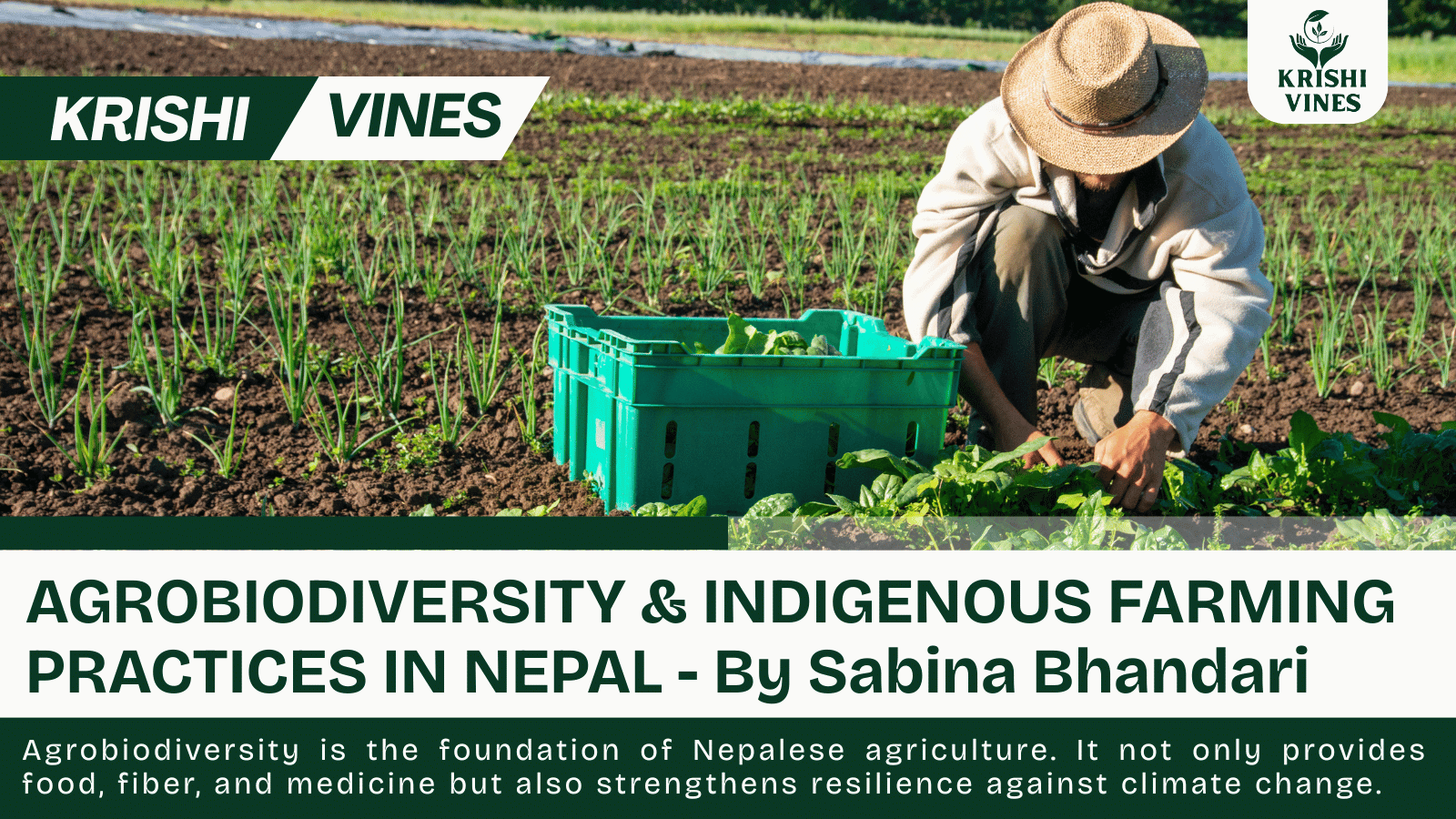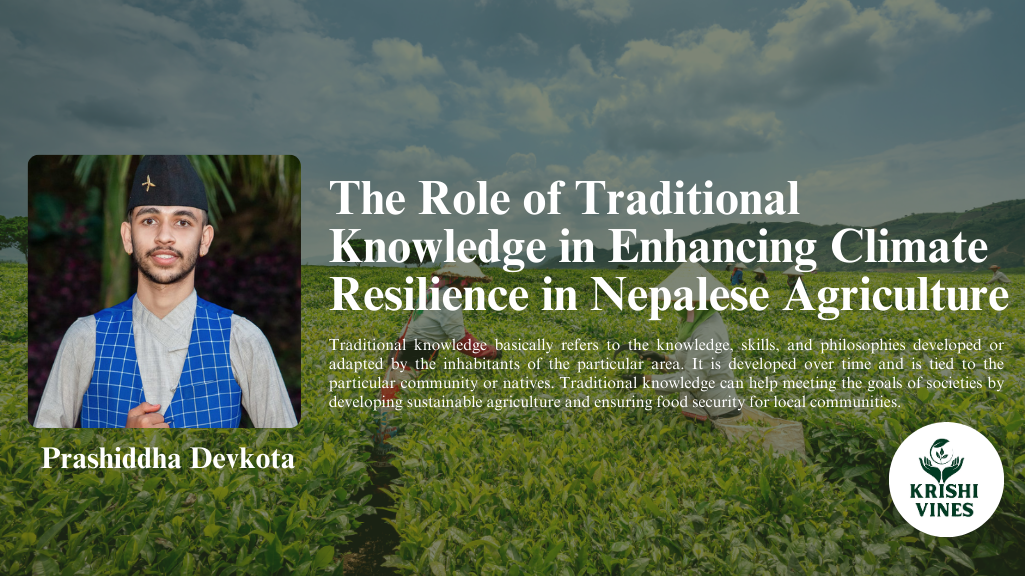
Traditional knowledge basically refers to the knowledge, skills, and philosophies developed or adapted by the inhabitants of the particular area. It is developed over time and is tied to the particular community or natives. Traditional knowledge can help meeting the goals of societies by developing sustainable agriculture and ensuring food security for local communities. Traditional knowledge helps in enhancing the climate resilience or to be prepared for the hazardous aspects of climate change. Since, the civilization started, agriculture has been remained as major part of the peoples profession. From such time Nepalese have been adapting various practices to cope with the climate risks. Some of the traditional knowledge in prevalence are rotational cropping, intercropping use of traditional crop varieties etc. Our vedas like Atharvaveda includes some techniques or practices like rainwater harvesting, construction of ponds and maintaining irrigation systems like guhar are key examples of traditional water management practices. Yajurveda and Rigvedas are oldest scriptures which often emphasizes on balanced relation between human, environment and cosmos which advocates for harmony of nature and human cultivation practices. Some of the traditional implements and methods can be described below:
Homegarden is a powerful traditional tools for enhancing climate resilience by promoting biodiversity,ensuring food safety, conserving water and soil, sequestering carbon, and fostering social and cultural resilience. Thus homegarden is a small-scale, agroforestry system usually located neat the periphery of house where diverse crops, trees are cultivated and livestock are reared under common management system providing multiple ecosystem benefits and fulfilling human needs.Homegarden is often overlooked as being heterogenous blend of large variety of small scale structures that may acts as refuge for many species, as well as valuable network of habitats for spatially separated populations. Several archetypal spaces has been recognized as homegardens which promotes biodiversity and thus ultimately enhance climate resilience i.e. vegetable gardens preserves various kinds of natural habitat of vegetables including commercial and non-commercial typical land suitable traditional varieties, flower garden preserves various kinds of wild flowers which can serve as the gene pool for conservation of it, tree garden often fosters for carbon sequestration, lawn gardens as biodiversity indicator , and other shrubs hedges, ponds gardens serves to provide various ecosystem benefits offering various services (Gabriel R, 2022). Nepalese farmers have long practiced agroforestry systems i.e. planting trees with crops which provides multiple benefits. Trees provides considerable benefits to nature such as windbreaks, reduce soil erosion, improve water retention, sequestering carbon in biomass and soils. Agroforestry has promising ability to conserve buffer crops from climate extremes. It can increase adaptive capacity, and help cope climate risks. It creates microclimates for various sustaining wild animals and microbes. Also it can increase resilience of agricultural soils by increasing carbon and nitrogen as well as improving microbial status of soil(Quandt et al., 2023).Traditional knowledge is also inclusive of forecasting of weather based on natural indicators of environment such as animal behavior, plant flowering patterns, sensitivity, anomaly in the wind and clouds changing patterns. Although modern meterological tools are more prominent nowadays but in rural areas traditional tools and knowledge still prevails However local tools along with modern ones if combined in more beneficial and exploitable way helps farmers anticipate upcoming events and apply necessary measures to cope with that. Thus by blending up of traditional forecast tools and modern equipments, more comprehensible strategies can be buildup addressing climate change and enhancing the climate resilience. In Nepal, traditional resource management practices are often community driven. Local instiutions like guthi or forest user groups, or community based organizations or cooperatives or microfinance are often associated in uniting to perform collective operation to fulfill a goal. The rising world issue i.e. climate change can be solved at particular local levels by organizing the people in a social cohesive boundary sharing responsibility among each other in addressing such impact of climate change. Some of the measures performed by community to address such are afforestation practices, no plastic use community, prevention of over-exploitation of resources, rotational grazing etc. Rooftop rain water harvesting or traditional tanks have been a part of Nepalese households in rural areas since decades to prevent the problem of drought and water scarcity. Terracing and contour bunding is a traditional practice to cope up with erosion in hills. Nomadic people who live in transhumance system, residing in various parts of Nepal often exploits to different places that allows their farming produce to sustain from changes in climate. These techniques helps to deal with climate change. As being country that gives huge value to the religious significance, many indigenous culture protect sacred groves i.e. areas besides forest or natural vegetation that are preserved for their religious importance. The world is currently facing significant concentration of atomospheric carbon di-oxide resulting in the greenhouse effect and ultimately resulting global warming which is the prominent cause of climate change. Biochar is a kind of charcoal that can alleviate the climate change. Biochar, an aromatic substance that persists in environment for an extended period of time is primarily composed of carbon, hydrogen and oxygen that absorbs greenhouse gases. Biochar also mitigate climate change by sequestering carbon in the soil, also it indirectly benefits in enhancing climate resilience by improving soil fertility, water retention capacity, and nutrients cycling (Kishan Nandi Shoudho, 2024). Shifting cultivation if done in controlled manner, maintain soil fertility and prevents permanent deforestation. Shifting cultivation also known as slash burn technique of farming is also nomadic way of cultivation practices adapted in rural Nepal. Forested areas regenerate naturally after farming. This system is stable when the ratios of fallow period to cultivation phages are 10 or more, but breaks down causing soil degradation and productivity loss when fallow period is reduced than mentioned threshold time. (R.Lal, 2015). Subsumed populations under categories like ethnic minorities, tribal people, hill tribes, or aboriginal people practice shifting cultivation i.e. short span of cultivation followed by long span of natural or improved fallow land. It is often overlooked to cause deforestation though it is found to cause forest modification. More carbon is being sequestered in areas under shifting cultivation than other form of land use, like permanent cropping of seasonal plants or plantations. (UNFCC Intersessional Meeting, 2009). Composting and organic farming practice is traditional method of cultivation followed in traditional farming methods that helps to improve soil health and it’s ability to sequester carbon, and promotes sustainable farming by reducing reliance on fossil fuel based inputs. Natural pest control without synthetic pesticide use is also a persistent factor alleviating climate risks. The use of herbal extracts, companion crops, crop rotation, crop diversification helps to alleviate imposed climate risks. Establishment of buffer zones, parks, restricted areas are also techniques in protecting nature thereby alleviating climate stress.
Indigenous people cultivates about 25% of the world’s land, which contains abundant biodiversity and carbon stored in soils along with biomass. These land is majorly occupied by forests that are central to the traditions,cultures and livelihoods of 70 million indigenous peoples, towards globe safekeeping and environmental stewardship to at least 36% of the world’s intact forests. (UNDP, 2024) Because of their close interconnection with nature, their ecological knowledge is intergenerational or societal. They are the first people who notice any abnormality of nature if their traditional knowledge can be exploited ,resilience efforts of climate change can be optimized.
References
“Biochar in Global Carbon Cycle: Towards Sustainable Development Goals – ScienceDirect.” Accessed October 20, 2024. https://www.sciencedirect.com/science/article/pii/S2666086524000146.
“Briefing Paper Shifting Cultivation3,” n.d.
“Contribution of Home Gardens to Sustainable Development: Perspectives from A Supported Opinion Essay – PMC.” Accessed October 19, 2024. https://pmc.ncbi.nlm.nih.gov/articles/PMC9603381/.
“Shifting Cultivation – an Overview | ScienceDirect Topics.” Accessed October 20, 2024. https://www.sciencedirect.com/topics/agricultural-and-biological-sciences/shifting-cultivation.
“The Benefits of Home Gardening,” January 11, 2023. https://www.bayer.com/en/agriculture/benefits-of-home-gardening.
Quandt, Amy, Henry Neufeldt, and Kayla Gorman. “Climate Change Adaptation through Agroforestry: Opportunities and Gaps.” Current Opinion in Environmental Sustainability 60 (February 1, 2023): 101244. https://doi.org/10.1016/j.cosust.2022.101244.
UNDP Climate Promise. “Indigenous Knowledge Is Crucial in the Fight against Climate Change – Here’s Why.” Accessed October 20, 2024. https://climatepromise.undp.org/news-and-stories/indigenous-knowledge-crucial-fight-against-climate-change-heres-why.