


Article
The article categories in an agriculture website encompass a wide range of topics relevant to the agricultural industry. These categories often cover areas such as crop cultivation techniques, livestock management, agricultural machinery and technology, organic farming practices, soil health and fertility, pest and disease management, agricultural economics and markets, agricultural policy and regulations, sustainable agriculture, climate-smart farming, and agricultural research and innovation. These categories serve as a repository of valuable information and resources for farmers, agronomists, researchers, and individuals interested in various aspects of agriculture.
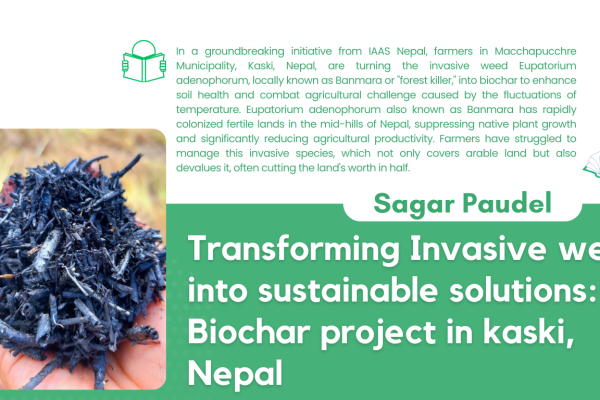
Transforming Invasive weed into sustainable solutions: Biochar project in kaski, Nepal || Krishi Vine
In a groundbreaking initiative from IAAS Nepal, farmers in Macchapucchre Municipality, Kaski, Nepal, are turning the invasive weed Eupatorium adenophorum, locally known as Banmara or “forest killer,” into biochar to enhance soil health and combat agricultural challenge caused by the fluctuations of temperature. Eupatorium adenophorum also known as Banmara has rapidly colonized fertile lands in…

How AI is Revolutionizing Agriculture: A Deep Dive into Advanced Models – By Gaurab Dhakal || Krishi Vines
Introduction Agriculture has been the backbone of human civilization for thousands of years, developing along with technological development. Nowadays, AI leads in agriculture’s revolution, enabling farmers to increase outputs, optimize resources, and even make exact predictions. From crop monitoring, disease detection, climate resilience, and irrigation optimization, AI models are changing modern farming making a big…
The Importance of Organic Farming in Enhancing Soil Fertility and Protecting the Environment – By Binita Dhakal || Krishi Vines
Organic farming is rapidly gaining recognition as a sustainable and environmentally friendly approach to agriculture. As concerns about climate change, soil degradation, and chemical pollution grow, organic farming is proving to be a crucial practice for enhancing soil fertility and protecting the environment. This holistic approach to farming is built on principles that prioritize soil…

Nepal: A Paradise for Birds – By Adhish Dulal || Krishi Vines
Nestled in the heart of the Himalayas, Nepal is not just a breathtaking landscape; it is also a sanctuary for an astonishing variety of bird species. With 896 different bird species, accounting for nearly 9% of all bird species globally, Nepal proudly holds the title of the “paradise of birds.” However, this natural treasure is…

A Need to Focus more on responsible and Sustainable Cereal Crops Production and Consumption – By Rahul Bikram Karki || Krishi Vines
Background The world population has now reached 8 billion and this growing global population requires growing agricultural production for their food. There is an estimation that the world population needs approximately 3,050 kilocalories (kcal) of food per person per day by 2030, which is an increase from 2,800 kcal available today. This reflects a significant…

Importance of Cover Crop in Soil Improvement – By Kamana Kumari Singh || Krishi Vines
IntroductionCover crops are those crop which are grown primarily to improve and protect soil health and manage other aspects of an agroecosystem, rather than for harvest. Cover crops manage soil erosion, soil fertility, soil quality, water, weeds, pests, diseases, biodiversity and wildlife in an agroecosystem—an ecological system managed and shaped by humans. Cover crops can…

Unlocking Soil Potential with Biochar – By Prajwal Ranabhat || Krishi Vines
Introduction: Biochar is a stable solid, rich in carbon, that is made from organic waste material or biomass that is partially combusted in the presence of limited oxygen. The primary purposes of biochar in soils are to improve aeration, decrease greenhouse gas emissions, decrease nutrient leaching, lower acidity, and raise soil water content in coarse…
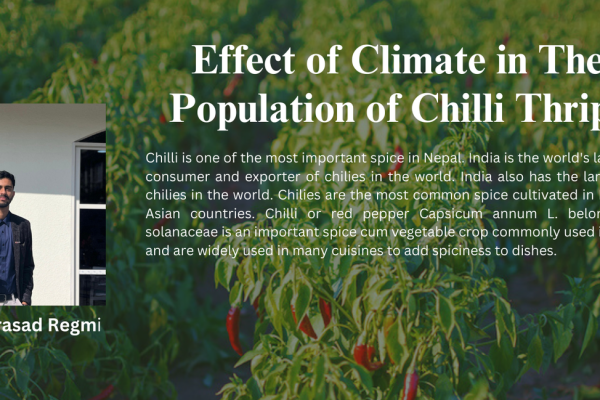
Effect of Climate in The Population of Chilli Thrips- By Yagnya Prasad Regmi || Krishi Vines
Introduction Chilli is one of the most important spice in Nepal. India is the world’s largest producer, consumer and exporter of chilies in the world. India also has the largest area under chilies in the world. Chilies are the most common spice cultivated in Nepal and other Asian countries. Chilli or red pepper Capsicum annum…

The Role of Youth in Agricultural Development in Nepal – By Manushi Sigdel || Krishi Vines
Agriculture remains a cornerstone of Nepal’s economy, employing over 60% of the population and contributing approximately one-quarter of the country’s GDP (Nepal Central Bureau of Statistics, 2021). However, the sector faces significant challenges, including climate change, rural depopulation, and outdated farming practices. In this context, the involvement of youth in agriculture is not just important;…

The Impact of Fungal Pathogens on Plant Health: A Comprehensive Review – By Upendra Bhusal || Krishi Vines
Abstract Fungal pathogens significantly affect plant health, leading to substantial economic losses in agriculture and disrupting natural ecosystems. This review synthesizes current research on fungal pathogenicity mechanisms, infection symptoms, and successful management approaches. By understanding the dynamics between fungal pathogens and host plants, we can develop better practices to mitigate their impact. Introduction…
